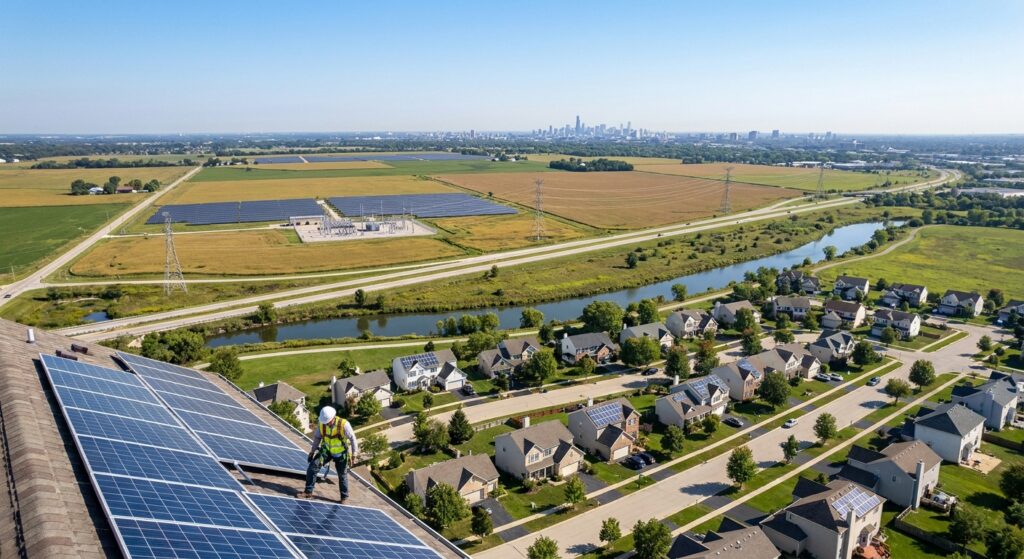
Going solar in Illinois starts with a question that has nothing to do with panels: who delivers your electricity? For homes and businesses across northern Illinois, including Chicago and Rockford, the answer is ComEd. Across much of central and southern Illinois, including Peoria, Champaign and Normal, it is Ameren Illinois. ComEd solar and Ameren solar follow the same state framework, but each utility runs its own paperwork, its own review process and its own billing, and those differences shape what the months after you sign actually look like.
This guide walks through what changes by territory and what stays the same: interconnection, how net metering credits show up on your bill, how Illinois Shines works statewide, and the utility questions worth raising with any installer. Windfree Solar has worked in both territories since 2009, so this is the version we would want a neighbor to read before their first conversation with anyone.
Summary
- Your utility, ComEd or Ameren Illinois, handles your interconnection application, installs or verifies your meter and grants permission to operate.
- Net metering works the same way in principle in both territories, but the credit follows each utility’s approved tariff and appears on that utility’s bill.
- Illinois Shines is a statewide program, so it is available whether your meter is ComEd or Ameren.
- Some Illinois communities are served by a municipal utility or an electric cooperative, which sets its own solar rules. Springfield and Naperville are two examples.
- Solar is custom. Your roof, your sun exposure and your utility account all shape the design, so ask how your specific territory will be handled.
First, Find Out Which Utility Serves Your Meter
It sounds obvious, but it is worth checking before anything else. Look at the top of your electric bill. If it says ComEd or Ameren Illinois, you are in one of the two large investor owned utility territories, and the state’s net metering and interconnection rules apply to you.
If your bill comes from your city or from a cooperative, you are in a different situation. Springfield, for example, is served by City Water, Light and Power, a municipal utility, and Naperville runs its own electric utility as well. Municipal utilities and cooperatives set their own policies on how solar customers are connected and credited, so the details in this guide may not match your account. Ask your installer to confirm your utility’s current rules before a design is finalized.
How Interconnection Works in ComEd and Ameren Territory
Interconnection is the formal process of getting permission to connect a solar system to the grid. The Illinois Commerce Commission sets the standards both ComEd and Ameren Illinois follow, but each utility runs its own application system, its own review queue and its own inspection and metering steps. The forms look alike, and the process can move very differently in practice.
For a typical residential project, the sequence looks like this:
- Site review and design. Your installer looks at your roof or site, sun exposure and electrical service, and designs a system around your usage.
- Interconnection application. The installer submits the application to your utility, ComEd or Ameren Illinois, with the system design and equipment details.
- Utility review. The utility reviews the application and approves it, requests changes or asks for more information.
- Permits and installation. Local permits are pulled and the system is installed.
- Inspection. The local authority inspects the work, and the utility completes its own steps, which can include a meter change or verification.
- Permission to operate. The utility grants permission to operate (PTO), and only then is the system turned on.
The steps are the same in both territories. What differs is the portal, the forms, the turnaround and the specific things each utility’s reviewers look for. Both utilities can be time consuming to work with, which is why it matters who is doing the back and forth on your behalf. Commercial projects follow the same basic path with more engineering review, and the larger the system, the more coordination it takes with the utility.
Net Metering Basics, by Utility
Net metering is how your utility accounts for the power your system sends to the grid. When your panels produce more electricity than your home or building is using in that moment, the extra flows out through your meter. The utility records it and applies a credit to your bill, which offsets electricity you pull from the grid later, like at night or on a cloudy stretch in January.
In both ComEd and Ameren territory, that credit is governed by Illinois law and each utility’s approved tariff. How the credit is calculated, which parts of your bill it applies to and how it carries forward are set by those rules, not by your installer. Illinois has updated its net metering rules for new solar customers in recent years, so a friend’s experience from several years ago may not match yours.
You will still receive a bill from your utility after going solar. There are always charges to stay connected to the grid, and the credits appear as line items on that bill. If you are in ComEd territory, our section by section guide on how to read your ComEd bill shows where those credits appear.
If You Buy Supply From a Third-Party Supplier
In Illinois, many customers buy their electricity supply from an alternative retail supplier while the utility still delivers the power. If that describes your account, ask how your supplier handles net metering credits before you go solar. It can change how the credit appears and what it offsets.
Batteries and Utility Programs
If you are adding a battery, your utility’s programs matter too. ComEd customers may hear about virtual power plant programs that let enrolled batteries support the grid. Our post on virtual power plants in Illinois explains how those programs work and what enrollment involves.
Illinois Shines Works Statewide
Illinois Shines, also known as the Adjustable Block Program, is administered by the Illinois Power Agency. The Illinois Shines program is a state incentive that supports solar PV development through the purchase of renewable energy credits (RECs). A REC represents the renewable attribute of the electricity your system produces, separate from the electricity itself.
Because the program is statewide, your utility does not decide whether you can take part. A homeowner in Chicago on ComEd and a homeowner in Champaign on Ameren apply through the same program, through an Approved Vendor. If your application is successful, your system will be part of Illinois Shines, and the RECs it generates will be sold to keep the cost of your panels affordable. Windfree Solar is an Approved Vendor under the Illinois Shines program.
Program rules and capacity change over time. For what changed most recently for homeowners, see our post on Illinois solar incentives, and for the broader question of whether solar makes sense for your home, our honest 2026 answer on whether solar panels are worth it in Illinois.
Utility Questions to Raise With Your Installer
Whoever you talk to, these questions will tell you how your specific territory will be handled:
- Which utility serves my meter, and have you completed interconnection with that utility before?
- Who submits the interconnection application, and who follows up with the utility until permission to operate is granted?
- How will net metering credits appear on my bill under my utility’s current rules?
- Will my system be enrolled in Illinois Shines, and what does that mean for the RECs it produces?
- If I buy supply from a third-party supplier, or I am served by a municipal utility or cooperative, what changes?
Good answers will be specific to your account, not general to Illinois. If you are still deciding whether your home is a candidate at all, start with our guide to telling if your roof is a good fit.
How Windfree Solar Handles Both Territories
Windfree Solar has been designing and building solar in Illinois since 2009, with 1,200+ systems installed across Illinois and the Midwest in both ComEd and Ameren territories. We manage the full scope of every project: sales, engineering, permitting, procurement of materials, interconnection, inspection and permission to operate. We hire small contractors for the on-site installation, so they can focus on the physical work while we make sure the project is complete every step of the way, including all of the back and forth with the utility.
On commercial and public work, Windfree operates as an EPC, meaning engineering, procurement and construction under one contract. One example in Ameren territory is Heartland Community College in Normal, where we worked through the project’s electrical contractor as design-assist and turnkey installer on a net zero agricultural building. You can see more of that work on our projects page.
Frequently Asked Questions
Is net metering different for ComEd and Ameren customers?
The principle is the same. Both utilities credit you for the extra power your system sends to the grid, under Illinois law and each utility’s approved tariff. The way the credit is calculated and shown on your bill follows your own utility’s rules, so ask your installer how it works for your account.
Can I join Illinois Shines if I am an Ameren customer?
Yes. Illinois Shines is a statewide program, open to ComEd and Ameren customers alike. You apply through an Approved Vendor, and if your application is successful, your system becomes part of the program.
Does my utility install the solar panels?
No. Your installer designs and builds the system. Your utility reviews the interconnection application, handles metering and grants permission to operate before the system is turned on.
What if my electricity comes from a municipal utility or cooperative?
Municipal utilities, like City Water, Light and Power in Springfield, and electric cooperatives set their own rules for connecting and crediting solar. Confirm your utility’s current policy with your installer before you commit to a design.
Will I still get a bill from ComEd or Ameren after going solar?
Yes. There are always charges to stay connected to the grid, and your net metering credits appear on that bill. The cost will never be zero.
Talk to Someone Who Works in Your Territory
Every utility account is a little different, and solar is custom. If you want to know how going solar would work for your home or building in ComEd or Ameren territory, contact Windfree Solar and we will walk through your specific situation.
You can also stop by the Solar Cafe at 517 Dempster Street, Evanston, IL 60201, and ask your questions in person.