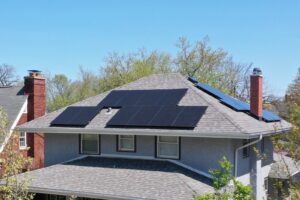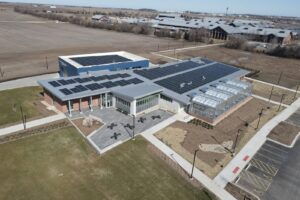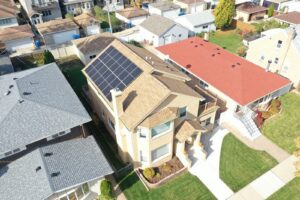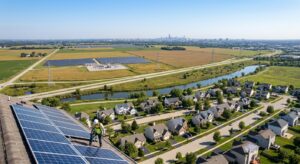
Congregations and community organizations across Chicago are asking the same question about solar for churches and nonprofits: can a building that was never designed for solar carry an array, and what does it take to get there? A historic church roof, a tight budget and a board that has to sign off are a different starting point from a new commercial building, and the planning should reflect that.
This guide walks through what solar looks like for faith communities and nonprofits, using projects Windfree Solar has completed on Chicago and Evanston churches and community buildings. It covers historic and steep roofs, how the federal credit can reach a tax-exempt organization, the choice about renewable energy credits, and the steps from first conversation to permission to operate. Windfree Solar has been designing and building solar in Illinois and the Midwest since 2009.
Summary
- Solar is custom. A church or community building’s roof, sun exposure, electrical service and how it uses power shape the system, not its size alone.
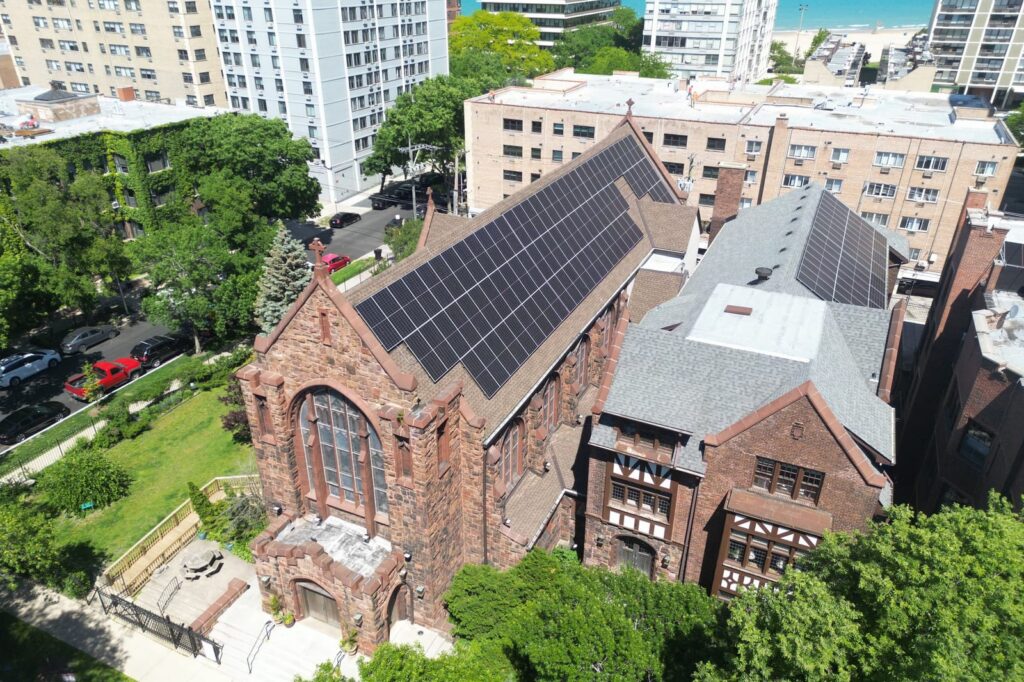
- Historic and steep roofs can carry solar. Windfree’s 68 kW array on the Church of the Atonement in Edgewater sits on a steep roof on a Gothic Revival church dating from 1889.
- Tax-exempt organizations can use elective pay to receive the value of the federal credit as a payment from the IRS, subject to the same construction and placed-in-service dates as any other commercial project.
- When solar lowers energy costs, more of the budget is left for the programs and services an organization exists to provide.
- Whether you sell or keep your system’s renewable energy credits decides what you can say about the building’s energy, so it is worth deciding early.
Recent Church and Community Projects
Some of the clearest examples of what is possible come from church and community buildings Windfree has worked on.
Church of the Atonement, Edgewater
The Church of the Atonement in Chicago’s Edgewater neighborhood is a Gothic Revival church dating from 1889, with a steep roof pitch. Windfree installed a 68 kW solar array on the building, one of the most challenging and rewarding Chicago projects the team has taken on. The system uses LONGi 545W solar modules, Chint inverters and IronRidge racking.
In October, the church celebrated the official blessing of the array. 48th Ward Alderperson Leni Manaa-Hoppenworth joined the celebration, along with community partners from CUB Illinois, Faith in Place and Illinois Solar for All. You can see the post from the blessing on Windfree’s Instagram.
Augustana Lutheran Church of Hyde Park
Windfree worked with Augustana Lutheran Church of Hyde Park and Lutheran Campus Ministry to install a rooftop solar array on the church. The system uses LONGi 545W solar modules, SolarEdge inverters and optimizers, and Unirac racking.
Grace Lutheran Church, Evanston
Grace Lutheran Church in Evanston has a 28.9 kW solar array installed by Windfree, built with Goldi 590W solar modules, SolarEdge power optimizers and inverters, and IronRidge racking. As Windfree shared when the project was finished, the system will help the church save on energy costs, so it can put more resources toward community programs and outreach.
Narrow Bridge Arts Club, Hyde Park
The Narrow Bridge Arts Club in Hyde Park occupies a historic building from 1923 that previously served as both a synagogue and a church before becoming a community arts hub. Windfree installed a 70 kW rooftop solar array there, using REC 400W solar modules, SolarEdge power optimizers and inverters, and Sunmodo racking.
More of this work is on Windfree’s projects page and on the Windfree Solar Facebook page.
Historic and Steep Roofs
Many church buildings in Chicago are decades old, and their roofs were designed for weather and appearance, not for equipment. That does not rule out solar, but it does change the planning.
- Sun exposure. Neighboring buildings, trees, towers and steeples all cast shade. A large roof is not automatically a productive one, and the site itself matters: a better site produces a better return.
- Roof pitch and material. A steep pitch affects how the crew works safely and how the racking attaches. The Church of the Atonement shows a steep, historic roof can carry an array when it is planned for.
- Roof condition. An array is a long-term addition, so the roof under it should be in good shape before installation. Roof attachments are coordinated so the roof warranty is respected.
- Electrical service. Older buildings often have older electrical service. Where the system ties in, and the route the conduit takes, are part of the design from the start.
- Appearance. On a building people care about, where the panels sit and how they look from the street matter. Layout is part of the design conversation, not an afterthought.
The Federal Credit and Elective Pay
Churches and nonprofits generally do not owe federal income tax, which used to put the federal solar credit out of reach. Elective pay changed that. According to the IRS, tax-exempt and governmental entities can benefit from certain clean energy credits through elective pay, sometimes called direct pay, and receive the value of the credit as a payment from the IRS.
The credit now has a deadline. Under the One Big Beautiful Bill Act (OBBBA), enacted in 2025, eligibility depends on when construction began. The IRS set out the rules in Notice 2025-42.
- Construction began on or before July 4, 2026: the project is not subject to the new termination date. The IRS continuity safe harbor generally gives it until the end of the fourth calendar year after construction began to be placed in service.
- Construction began after July 4, 2026: the system must be placed in service by December 31, 2027 to qualify.
For a congregation or board that meets monthly, that calendar matters. Approvals, fundraising and design all take time, so it helps to start the conversation well before the date is close.
Whether your organization qualifies, and how any credit applies to it, depends on its tax situation. Check with your tax advisor. We don’t give tax advice.
What Lower Energy Costs Make Possible
For a church or nonprofit, an energy bill is money that is not going to the mission. Solar can lower ongoing energy costs, which leaves more of the budget for the programs and services an organization exists to provide, whether that is outreach, education, arts programming or caring for the building itself. Solar is custom, so what any one building can expect depends on its roof, its site and how it uses power.
Selling or Keeping Your Renewable Energy Credits
A solar system generates renewable energy credits (RECs) along with electricity. Illinois Shines, the Adjustable Block Program administered by the Illinois Power Agency, is a state incentive that supports solar PV development through the purchase of RECs. If your application to the program is successful, your system will be part of Illinois Shines. Windfree Solar is an Approved Vendor under the Illinois Shines program.
For a faith community or nonprofit, this choice deserves real thought. If the RECs are sold, they help keep the cost of the system affordable, but the organization cannot then claim to run on renewable energy. If they are retained, the organization keeps that claim. For a congregation whose interest in solar is tied to its climate commitments, it is worth deciding at the design stage which matters more.
How a Church or Nonprofit Project Comes Together
- First conversation. We look at the building, the roof, the sun exposure and the electrical service, and talk through what the organization wants solar to do.
- Design. Solar layout, structural review and electrical concepts, with attention to how the array looks on the building.
- Approvals. Most organizations need a board, council or vestry to sign off, so it helps to build that step into the timeline.
- Contract and incentives. Labor requirements and the incentive strategy, including elective pay and RECs, are confirmed.
- Permits and installation. Local permits are pulled, roof attachments are coordinated, and the system is installed.
- Interconnection and permission to operate. Windfree handles the back and forth with ComEd or Ameren and commissions the system through to permission to operate (PTO), the utility’s approval to switch it on.
For how the utility side differs by territory, see our guide to ComEd solar versus Ameren solar.
Working With Windfree Solar
Windfree Solar has installed 1,200+ systems across Illinois and the Midwest since 2009. We are a Certified Minority Owned Business (MBE) and an Equity Eligible Contractor (EEC), and we manage the full scope of every project: sales, engineering, permitting, procurement of materials, interconnection, inspection and permission to operate.
We are also a Solar Insure certified provider, which not every installer can be. On qualifying systems that means a 30-year warranty covering equipment and labor.
Frequently Asked Questions
Can a historic church roof support solar?
Often, yes. It depends on the roof’s condition, structure, pitch and shade. The Church of the Atonement, a Gothic Revival church dating from 1889 with a steep roof, now carries a 68 kW array. A site review is the way to find out for a specific building.
Can a church or nonprofit benefit from the federal solar credit?
Tax-exempt organizations can use elective pay to receive the value of the credit as a payment from the IRS, subject to the same construction and placed-in-service dates as any other commercial project. Check with your tax advisor. We don’t give tax advice.
How long does a project take?
It depends on the building, the approvals your organization needs and the utility’s interconnection process. Starting early gives your board time to decide without pressing against the federal credit dates.
Can we say our building runs on solar?
Only if you keep your renewable energy credits. If the RECs are sold through Illinois Shines, the organization cannot claim to run on renewable energy. It is a choice worth making at the design stage.
Do you work with buildings outside Chicago?
Yes. Windfree works across Illinois and the Midwest, in both ComEd and Ameren territory.
Talk Through Your Building
Every building is different, and solar is custom. If your congregation or organization is thinking about solar, contact Windfree Solar, email sales@windfree.us, or call 312-588-6953, and we will walk through your building, your goals and your timeline.