
If you are wondering how to read your ComEd bill after going solar, you aren’t alone the transition to clean energy changes your statement significantly. You check your mail one day, and there it is your first ComEd bill since going solar.
You open it expecting to see a small number, maybe even a credit. Instead, you see charges. And credits. And line items you’ve never noticed before. Suddenly, you’re not sure if your solar is actually saving you money.
Take a breath. This is normal.
When you go solar in Illinois, your ComEd bill changes in ways that can be confusing at first. But once you understand what you’re looking at, you’ll see exactly how much you’re saving—and why some charges still appear even when your panels are producing.
Here’s how to read your bill like a pro.
How to Read Your ComEd Bill: Why It Looks Different After Solar
Before solar, your ComEd bill was simple. You used electricity, they measured it, you paid for it. But when you start generating your own power, the utility needs to track what you use and what you send back.
The Old Way vs. The New Way
If you installed solar before January 1, 2025, you were on the old net metering system. Every kilowatt-hour you sent to the grid was credited at the full retail rate—supply and delivery combined. Your bill could go to zero.
If you installed solar after January 1, 2025 (as most current homeowners have), you’re on Smart Solar Billing. This newer system works differently:
You receive credits only for the supply portion of your excess electricity
Delivery charges are not credited
You receive a one-time upfront rebate ($300/kW) to compensate
This change is the number one reason new solar owners get confused. You’re still saving money just not seeing it the way your neighbor with older panels might.
Why ComEd Needs to Track Two Flows
Your home uses electricity 24/7. Your solar panels produce electricity only when the sun is shining. Sometimes you’re using more than you’re producing (evening, night, cloudy days). Sometimes you’re producing more than you’re using (sunny afternoons).
ComEd needs to track both flows:
Imported power: Electricity you pull from the grid (you pay for this)
Exported power: Electricity you send to the grid (you get credited for this)
- Your bill reflects the net of these two flows, plus fixed charges that never go away.
- Use Windfree’s [solar savings calculator](Windfree calculator page) to estimate your monthly bill.
The Illinois Commerce Commission provides information on Smart Solar Billing rules.
Understanding Smart Solar Billing
Smart Solar Billing (also called “supply-only net metering”) is the system that took effect in Illinois on January 1, 2025. If you have a newer solar installation, this is what you’re on.
How Credits Are Calculated
Your solar production is measured by your meter. When you export power to the grid, you earn credits. Under Smart Solar Billing, those credits are calculated at the supply rate—approximately half the retail rate you pay for imported power.
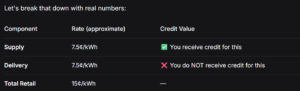
So if you send 10 kWh to the grid on a sunny afternoon, you’ll receive about $0.75 in credits (10 kWh × 7.5¢). If you later pull 10 kWh from the grid in the evening, you’ll pay about $1.50 (10 kWh × 15¢), but your $0.75 credit reduces that to $0.75 out of pocket.
The One-Time Rebate
To make up for the lower credit value, ComEd provides a one-time Distributed Generation (DG) rebate for new solar customers. This is currently $300 per kW of solar capacity . For a typical 8kW system, that’s $2,400—paid to you after your system is activated.
Think of it as ComEd pre-paying you for the delivery credits you won’t receive over the life of your system.
Why This System Actually Makes Sense
Smart Solar Billing is designed to better reflect the true value of solar power to the grid. The electricity you send back during sunny afternoons is genuinely less valuable to ComEd than the power you pull during evening peak hours, when demand is highest and generation is more expensive.
It also creates a stronger incentive to pair solar with battery storage. When you store your excess production and use it during evening hours, you avoid paying full retail rates for that power—a much better deal than selling it back for supply-only credits.
- Learn about [solar + battery options](Windfree battery page) to maximize your savings.
- The Environmental Protection Agency has resources on net metering and distributed generation.
Breaking Down Your ComEd Bill: Section by Section
Let’s walk through a typical ComEd bill for a solar customer so you know exactly what you’re looking at.
Customer Charge
This is the fixed monthly fee for being connected to the grid. It typically runs $15-$25 and appears on every bill, regardless of how much electricity you use or produce. This charge covers meter reading, billing, customer service, and grid maintenance.
Supply Services
This section shows:
- Electricity used: The total kWh you pulled from the grid
- Electricity credits: The kWh you sent to the grid
- Net usage: Your usage minus your credits
- Current charges: The cost of your net usage at the supply rate
This is where the magic happens. If your net usage is negative (you produced more than you used), you’ll see a credit balance that rolls over to future bills.
Delivery Services
This section covers the cost of transporting electricity to your home—the poles, wires, transformers, and infrastructure. Unlike the old net metering system, you do not receive delivery credits for power you export. You only pay delivery charges on power you import from the grid.
Taxes and Fees
Various state and local taxes apply to your net electricity charges and fixed fees. These are small but worth noting.
Bill Comparison
Here’s what a typical monthly ComEd bill might look like before and after solar:
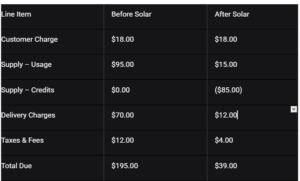
Note: Actual numbers vary based on system size, usage, and season.
As you can see, the fixed customer charge remains. Supply and delivery charges drop significantly because you’re pulling less from the grid. And credits from your solar production offset the supply portion of what you do use.
Your bill won’t be zero—but it will be dramatically lower, and that savings compounds over the life of your system.
Why You Still Pay Something Every Month
One of the most common frustrations new solar owners have is opening their bill and seeing a balance due—even though they produced more than they used.
Fixed Charges Never Go Away
No matter how much solar you have, you will always pay:
The customer connection fee ($15-$25/month)
Taxes on that fee (a few dollars)
Delivery charges on any power you pull from the grid
These charges typically add up to $25-$40 per month, even if your panels cover 100% of your usage.
Seasonal Variation
Solar production varies dramatically by season. In summer, you’ll likely overproduce and build up credits. In winter, shorter days and snow coverage mean you’ll underproduce and use those credits.
Your monthly bill might show charges in winter and credits in summer. The true picture comes from your annual true-up.
The Credit Rollover System
Under Smart Solar Billing, unused credits roll over month to month. They don’t expire at the end of the year. Instead, you get an annual true-up statement each March that shows your net position for the year.
The Annual True-Up: Where the Real Magic Happens
Once a year—typically in March ComEd sends you an annual true-up statement. This document tells the real story of your solar savings.
How It Works
Your true-up statement shows:
- Total electricity used for the year
- Total electricity produced by your panels
- Net position (overproduced or underproduced)
- Monetary value of your net position
If you overproduced for the year, ComEd sends you a check for the net value at the supply rate (about 7.5¢/kWh).
If you underproduced, you’ll owe the difference for the power you pulled from the grid.
What Most Solar Owners See
Most well-sized systems end up within 10% of net zero annually. Some years you overproduce by a small amount; some years you underproduce. The swings even out over time.
Why Your True-Up Might Be Small
If you’re wondering why your true-up check isn’t larger, remember that you already received a $300/kW rebate upfront. That rebate effectively pre-paid for the delivery portion of your exported power. The true-up covers only the supply portion.
What to Do If Your Bill Seems Too High
Sometimes a bill looks wrong. Here’s how to troubleshoot.
Check Your Solar Monitoring App
Your inverter should have a monitoring app or web portal. Compare your production data to what ComEd is showing. If they don’t match, there may be a metering issue.
Review Your Net Usage
Look at the “Net Usage” line on your bill. If it’s positive (you pulled more than you sent), your system may be undersized or underperforming. If it’s negative (you sent more than you pulled), your bill should show credits.
Look for Estimated Readings
Occasionally, ComEd estimates meter readings instead of reading them. This will be noted on your bill. If your bill looks wrong, check whether it’s based on an actual or estimated reading.
When to Call for Help
If your bill consistently shows high charges despite your system producing normally, it’s worth a call to ComEd or your solar installer. Meter issues do happen, and they can usually be resolved with a quick investigation.
Frequently Asked Questions
Q: Why do I still have a bill if I have solar panels?
A: You’ll always pay fixed connection fees ($20-$40/month) and delivery charges on any power you pull from the grid. Your solar savings show up as credits that offset your usage charges.
Q: What’s the difference between Smart Solar Billing and net metering?
A: Smart Solar Billing (post-2025) gives you credits only for the supply portion of your excess power. Old net metering gave full retail credits. Smart Solar Billing includes a one-time upfront rebate to compensate.
Q: How much is the ComEd rebate for new solar customers?
A: $300 per kW of solar capacity. For an 8kW system, that’s $2,400.
Q: Why do I have a bill in winter when I overproduced in summer?
A: Solar production is seasonal. Summer overproduction builds credits; winter underproduction uses them. Your annual true-up tells the real story.
Q: Do solar credits expire?
A: No. Under Smart Solar Billing, credits roll over month to month and are settled annually in March.
Q: What is the annual true-up?
A: Once a year, ComEd calculates your net production for the year. If you overproduced, you get a check. If you underproduced, you pay the difference.
Q: Will my bill ever be zero?
A: You’ll always have fixed connection fees ($20-$40/month), even if you produce 100% of your usage. Your usage charges can go to zero, but the fixed fees remain.
Q: Who do I call if my bill looks wrong?
A: Start with ComEd’s customer service. If the issue seems related to your solar production, contact Windfree for assistance.
Your Next Step
Your ComEd bill after solar is different—but once you understand it, you’ll see exactly how much you’re saving every month. The fixed charges stay, but your usage charges drop dramatically. And the annual true-up is your reward for a year of clean energy production.
At Windfree Solar, we help Chicago homeowners navigate every step of the solar journey—including understanding your bills. If you ever have questions, we’re just a call away.
Contact Windfree Solar today for support with your solar system or to learn more.
*Serving homeowners throughout Chicago, Naperville, Evanston, Oak Park, and all surrounding suburbs with professional solar installation backed by 15+ years of local experience.*