A hotel never really turns off. Lobbies stay lit at 3 a.m., HVAC systems run around the clock to keep guests comfortable, and laundry operations can start before sunrise and run past midnight. That nonstop rhythm is exactly why solar for hotels requires a different design approach than a typical retail store or office building.
Summary
- Hotels run a 24/7 load profile, which means solar design has to account for overnight base load, not just daytime peaks.
- HVAC, laundry, and kitchen equipment drive the biggest demand spikes and are the best places to target solar and battery offset.
- Sun exposure, orientation, and available roof and lot area drive output more than square footage alone. Solar is custom.
- New builds get the cleanest integration when solar is designed in from day one, but retrofits on existing hotel roofs and structures are common and workable.
- Battery storage adds resilience for hotels that can’t afford downtime, protecting guest safety systems and revenue-generating operations during an outage.
Jump to a section:
- Why 24/7 Occupancy Changes the Solar Math for Hotels
- Where Solar Fits Into a Hotel’s Energy Load
- What a Hotel Actually Gets Out of Going Solar
- New Build vs. Retrofit: Designing Solar Into Hotel Construction
- Working With Your Project Team, GCs, Electricians, and Architects
- Battery Storage and Backup Power for Uninterrupted Hotel Operations
- What a Turnkey Hotel Solar Installation Involves
- Proof in the Field, Commercial Solar Projects Windfree Has Delivered
- Frequently Asked Questions
Why 24/7 Occupancy Changes the Solar Math for Hotels
Most commercial solar case studies come from buildings that empty out at night. An office tower, a warehouse, a school, they all have a load that drops close to zero after hours. A hotel doesn’t do that. Guests are sleeping under climate control, elevators are running, exterior and hallway lighting stays on, and the front desk never closes. That means a hotel’s overnight base load looks a lot more like a hospital’s than a retail store’s.
Solar panels only generate during daylight hours, so a system sized purely against a hotel’s daytime peak will leave a meaningful chunk of the overnight load untouched. That’s not a reason to skip solar, it’s a reason to design the system and any accompanying battery storage around the full 24 hour curve instead of the sunny half of it. Solar is custom, and nowhere is that truer than in hospitality.
Load Profiles: Hotels vs. Retail and Office Buildings
A retail store’s load usually peaks during business hours and falls off sharply at close. An office building follows a similar Monday through Friday, nine to five pattern. A hotel’s load has two distinct peaks instead: a morning surge as guests shower, run hair dryers, and the kitchen fires up breakfast service, and an evening surge as HVAC ramps for the night, laundry catches up, and common areas fill with guests. Between those peaks, the base load never really drops to zero. That flatter, higher overnight floor is the single biggest design difference between solar for hotels and solar for a typical commercial building.
Where Solar Fits Into a Hotel’s Energy Load
Even with a demanding overnight load, solar still does meaningful work for a hotel. Daytime production offsets the morning and midday demand directly, which is often when utility rates and demand charges are at their highest. Reducing the amount of grid power pulled during those windows can change a property’s utility bill structure, particularly for hotels on ComEd or Ameren rate schedules with demand charge components.
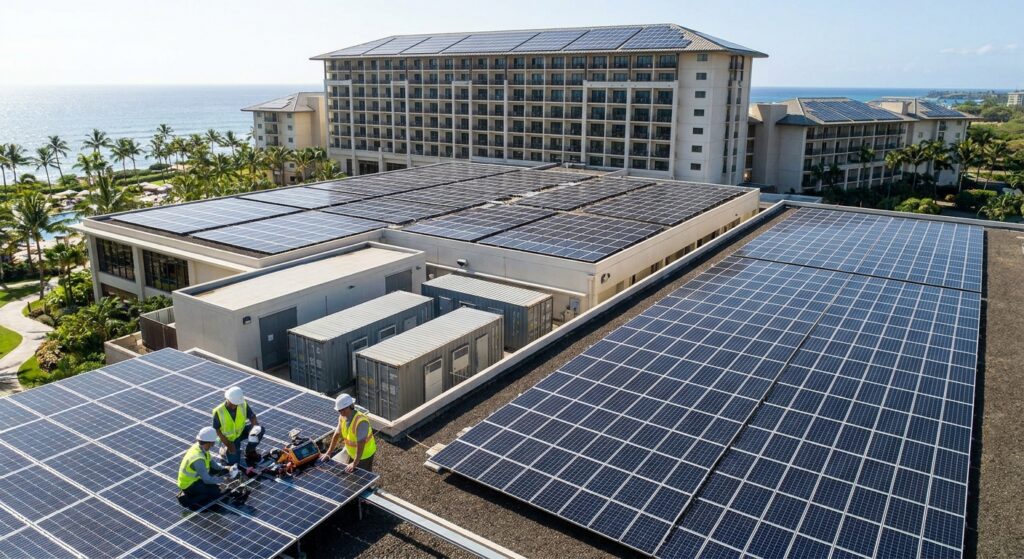
The other place solar fits well is on the roof and structural footprint hotels already have. Flat commercial roofs, parking structures, and even carports over guest parking are all viable mounting locations, and many hotel properties have more usable roof and lot area than the building’s own footprint would suggest. Sun exposure and orientation matter as much as raw square footage, since a large roof that is shaded for half the day will not perform like an open one. The site itself drives the outcome: better site, better return. For a property owner comparing options, our guide on solar panel cost by system size is a useful starting point for understanding how system size scales with a property’s actual usage.
Peak Demand Drivers: HVAC, Laundry, and Kitchens
Three systems drive the bulk of a hotel’s electric load, and they’re worth naming specifically because they’re where solar and battery storage have the most impact:
- HVAC: Climate control across guest rooms, corridors, and common areas runs continuously and represents the largest single load category in most hotels.
- Laundry: On-site or centralized laundry operations for linens and towels involve large motor loads and heating elements that spike demand in short bursts.
- Kitchens: Restaurant, banquet, and room service kitchens add heavy equipment loads concentrated around meal service windows.
Understanding which of these three is the biggest driver at a specific property is part of what a proper solar and battery design process should account for before a single panel goes on the roof.
What a Hotel Actually Gets Out of Going Solar
Set aside the general case for solar for a moment, because a hotel’s reasons are more specific than a typical commercial building’s.
Demand Charges and Rate Exposure
Commercial electric bills are not just a volume of kilowatt hours. A meaningful portion is often a demand charge, set by the single highest peak the property pulls in a billing period. A hotel’s morning and evening surges are exactly the kind of peaks that set those charges. Producing on site during the daytime portion of that curve, and shifting stored production into the evening, is a way of attacking the part of the bill that volume-based thinking misses entirely. We expect many Illinois properties to reduce their energy costs by generating on site, though what that looks like at a specific hotel depends on the rate schedule and the load, which is why the honest version starts with a load analysis rather than a promise.
Predictability Over a 25 Year Horizon
Utility rates move, and they have mostly moved in one direction. A solar array is a known capital cost against a quarter century of production, which changes the character of a portion of the property’s energy spend from variable to fixed. For an ownership group modeling a hold period, that predictability is often the part that matters more than any single year’s figure.
Resilience That Guests Actually Notice
Emergency lighting and fire systems are code, but code minimum is a dark hotel with working exit signs. Solar paired with storage can keep more of a property functioning through an outage, which for a hotel is the difference between an inconvenience and a night of refunds and bad reviews. This is covered further down.
The Sustainability Story, and How to Tell It Honestly
Hotel brands, corporate travel programs, and event bookers increasingly ask about a property’s energy profile, and on-site generation is a concrete answer rather than a pledge. One nuance worth understanding early, because it affects what a property may claim: the renewable attributes of the electricity a system produces can either be sold as certificates or retained by the owner, and that choice determines whether the property can describe itself as powered by renewable energy. Heartland Community College retained theirs in order to certify a building as net zero rather than monetizing them. It is a real decision with real tradeoffs, and it is worth making deliberately at design stage rather than discovering later.
A Note on Incentives
Federal, state, and utility incentive programs change, sometimes materially and sometimes with short notice, so a blog post is the wrong place to learn where they stand. Windfree does not give tax advice. What we can do is tell you what currently applies to a property like yours as of the day you ask, and your tax advisor confirms how it lands for your ownership structure. If your ownership group is exploring numbers for a specific site, our breakdown on why free solar calculators get it wrong in Illinois explains why generic online estimators miss commercial-scale nuances entirely.
New Build vs. Retrofit: Designing Solar Into Hotel Construction
Hotels come to solar from two very different starting points, and each one changes how the project should be approached.
On a new build, the best outcome comes from involving a solar design-assist partner during the architectural phase, not after the roof is already framed. We work from architectural plans and respect design intent. When specs call for products that are outdated, discontinued, or unavailable, we identify the closest viable alternatives and coordinate approvals, so the vision becomes a buildable, warrantable reality. Structural loads, conduit runs, and roof penetrations are all far easier to plan for than to retrofit later, and coordinating solar with the build sequence from day one avoids costly rework.
Retrofits are just as common, especially for hotel brands renovating existing properties or ownership groups adding solar to a portfolio asset. A retrofit means working around an existing roof membrane, existing electrical service, and often an occupied building that can’t go dark during construction. That’s a very different set of constraints than a ground-up build, and it requires a contractor who has actually done both. For hotels weighing whether to add solar now versus during a future renovation, our post on how commercial solar differs from residential systems is a useful primer on the scale and complexity difference.
The Things That Actually Go Wrong on a Hotel Build
Solar is the last trade in physically, but it should be contracted at the beginning. The gap between those two facts is where most of the trouble lives:
- Crane and site access. Landscaping and hardscape are often finished before the array arrives. Access needs have to be flagged before finishes go in.
- Conduit routing. Solar conduit gets treated as an afterthought. Runs should be planned during rough-in while walls are still open.
- Roof attachments and warranties. Coordinated with the roofer during installation, using non-penetrating solutions where the roof allows it.
- Specs that have aged out. Drawings frequently call for equipment that is discontinued by the time the job breaks ground. Early spec review and approved equivalents keep that from becoming a change order.
- Utility interconnection. ComEd and Ameren both take time, and on a hotel that timeline has to be planned around occupancy.
Working With Your Project Team, GCs, Electricians, and Architects
If you’re a general contractor, electrician, or architect on a hotel project and solar is already part of the plan, our job isn’t to convince the owner it’s a good idea, it’s to deliver a gold-standard system and make the process seamless for the entire project team. That means showing up to coordination meetings, respecting the construction schedule, and not treating solar as a bolt-on that happens after everything else is finished.
Illinois solar incentives also come with specific labor rules, particularly for public, union-labor, or institutional hospitality projects. Project teams shouldn’t have to become experts in solar labor compliance, that’s our job. Windfree operates as an engineering, procurement, and construction (EPC) firm, which is the classification that qualifies a project for certain public and union-labor solar work in the first place. We also work within whatever contracting structure fits the project, whether that’s owner-direct, through the GC, or through the electrical contractor of record.
To be clear about how the work actually happens: we hire small contractors to install that typically cannot or do not want to take on the full turnkey scope, including sales, engineering, permitting, procurement, interconnection, inspection, and permission to operate (PTO), so they can focus on the on-site work while we make sure the project is complete every step of the way.
Battery Storage and Backup Power for Uninterrupted Hotel Operations
A power outage at a retail store is an inconvenience. A power outage at a hotel is a guest safety issue, a life safety code issue, and a revenue problem all at once. Emergency lighting, elevators, and fire alarm systems need backup power regardless of solar, but pairing solar with battery storage adds a layer of resilience that can keep more of the property functioning through an outage instead of just the bare code minimum.
Battery storage also lets a hotel shift solar production from the middle of the day into the evening demand spike we described earlier, which is often when utility rates or demand charges are steepest. If you’re retrofitting an existing hotel system, our guide on adding battery storage to your solar system covers what to check before committing to a specific battery size or configuration, since undersizing a battery for a 24/7 building is a common and expensive mistake. Research from the National Renewable Energy Laboratory on solar-plus-storage performance is a helpful reference for how production and demand curves interact in commercial applications like this.
What a Turnkey Hotel Solar Installation Involves
A turnkey hotel solar project covers a lot of ground beyond the panels themselves. It starts with a site assessment and load analysis, moves into engineering and permitting, and continues through material procurement, installation coordination, interconnection with the utility, and final inspection. For a property that can’t afford extended downtime or disruption to guest operations, sequencing that work correctly matters as much as the equipment specified.
We can physically install faster, but the best results come when we’re involved from day one so everything is coordinated around the build sequence, whether that’s a new construction timeline or a phased renovation around an occupied hotel. Every commercial solar project in Illinois has to clear local permitting, pass inspection, and receive interconnection approval from ComEd or Ameren before it can be switched on, a process that ends with permission to operate (PTO). For a hotel, that has to be planned around occupancy and, in a renovation scenario, around guest bookings. A partner who has coordinated interconnection timelines with utility territories across Illinois and the Midwest can usually avoid the delays that catch first-time commercial owners off guard.
Proof in the Field, Commercial Solar Projects Windfree Has Delivered
Windfree has been designing and installing commercial solar in Illinois and the Midwest since 2009, with more than 1,200 systems delivered across residential and commercial properties. Our commercial client list includes Turano, Guinness, Revolution Brewing, and Heartland Community College, along with institutional projects like the Obama Presidential Center Athletic Center, DePaul University, and Somonauk High School. Our Heartland Community College case study is a good look at how a net zero new build comes together, including a 216 kW array with zero roof penetrations and a mid-project pivot to a union crew that stayed on schedule and under budget.
Windfree is also a certified Solar Insure provider, not every installer qualifies for that certification, and qualifying systems come backed by a 30 year warranty covering equipment and labor, underwritten via Zurich Insurance Group.
Frequently Asked Questions
How Much of a Hotel’s Energy Use Can Solar Realistically Offset?
It depends far more on available roof and lot area, sun exposure, orientation, and whether battery storage is paired with the system than on any fixed rule of thumb. Because a hotel carries a high overnight base load, the honest answer for any specific property comes out of a load analysis rather than a percentage you can look up.
Can a Hotel Go Fully Off-Grid With Solar and Battery Storage?
Technically possible, but rarely practical for a hotel. The 24/7 load, safety code requirements, and demand for guaranteed uptime mean most hotel solar projects are designed to significantly reduce grid reliance and add resilience during outages rather than eliminate the utility connection entirely. Staying interconnected also preserves access to net metering and utility programs an off-grid system would forfeit.
Does Installing Solar Disrupt Guests?
It should not, and avoiding that is a sequencing question rather than an equipment one. Most of the work happens on the roof or in electrical rooms, and on an occupied property it gets phased around bookings. The parts that need a brief service interruption are planned in advance rather than sprung on the property.
When in a Hotel Project Should Solar Be Contracted?
At the beginning, even though the physical work happens near the end. Structural loads, conduit routing, crane access, and roof attachment details are all far cheaper to plan than to retrofit, and a solar partner brought in at concept stage can shape those decisions rather than work around them.
Can Solar Go on a Hotel With a Flat Roof or Limited Roof Space?
Yes on flat roofs, which are common on hotels and often support fully ballasted, non-penetrating racking. Where roof area is genuinely limited, parking structures and carports over guest parking are worth looking at, and they frequently add more usable area than the building roof itself.
Hotels have a load profile that rewards good solar design and punishes lazy design. If your property, whether it’s a new build or a renovation, is ready to have that conversation, reach out to our commercial team at sales@windfree.us, call 312-588-6953, or visit our contact page to start a site assessment.