Most explanations of solar energy start with photons, semiconductors, and electron flow diagrams that look like they belong in a physics textbook. This is not that.
If you are a Chicago homeowner who wants to understand what is actually happening on your roof, and whether it makes sense for your home, this is where to start.
AI Summary / Key Takeaways
- Solar panels convert sunlight into electricity using cells made of silicon — no moving parts, no fuel, no combustion
- An inverter converts that electricity from DC to AC so your home can actually use it
- Excess electricity you don’t use goes back to the grid, earning you bill credits through ComEd net metering
- Solar works in Chicago winters — panels actually perform better in cold weather than in heat
- The typical residential system in Chicagoland covers most or all of a home’s electricity needs
The Short Version: What Solar Actually Does
Here is solar explained in three sentences.
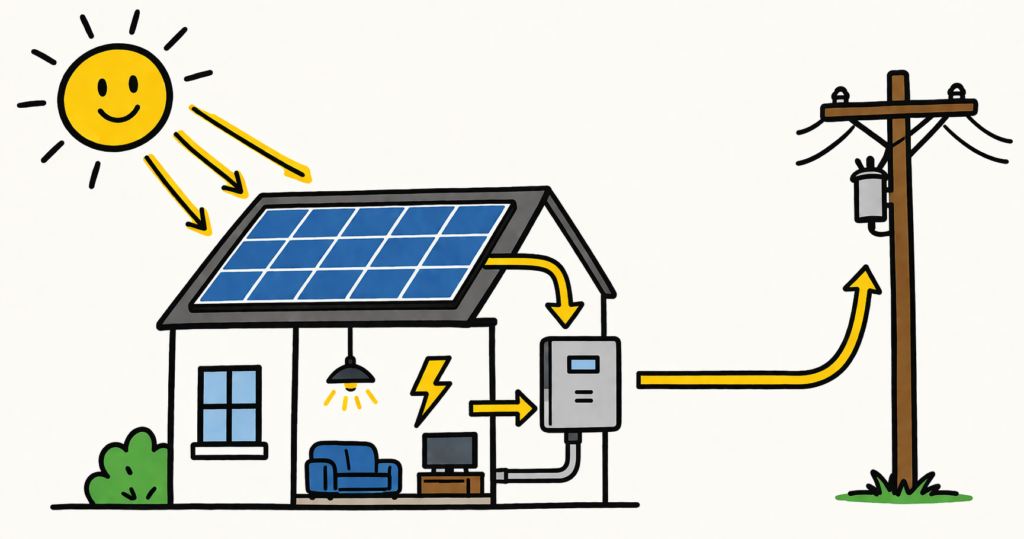
Sunlight hits panels on your roof. The panels convert that sunlight into electricity. Your home uses that electricity instead of buying it from ComEd.
Everything else — the incentives, the inverters, the net metering credits, the payback periods — is built on top of that simple exchange. Once you understand the core of it, the rest starts to make sense pretty quickly.
Breaking Down the Technology (Without the Physics Degree)
A residential solar system has three main components. Most people have heard of two of them. The third one does more work than it gets credit for.
The Panel Itself
Solar panels are made of photovoltaic cells, usually silicon, arranged in a grid behind tempered glass. When photons from sunlight hit those cells, they knock electrons loose and create an electrical current. That current is called direct current, or DC — the same type of electricity a battery produces.
Nothing burns. Nothing moves. There are no fuel costs, no emissions, and because there are no moving parts, almost nothing to break down. The panels Windfree installs carry 25-year performance warranties, and most continue producing beyond that. The technology is straightforward and proven — not new, not experimental. The first silicon solar cell was built in 1954, and the fundamentals haven’t changed since.
The Inverter: The Part Nobody Talks About
Your home doesn’t run on DC electricity. It runs on alternating current, or AC, which is what comes out of your wall outlets. Before your solar electricity can power your refrigerator, your lights, or your HVAC system, it needs to be converted.
That’s the inverter’s job.
The inverter sits between your panels and your home’s electrical panel and converts DC to AC continuously throughout the day. Modern string inverters handle the whole system at once. Microinverters, which Windfree uses on certain installations, attach to each panel individually and optimize output even when some panels are shaded. The inverter also communicates with the grid and contains the system’s monitoring technology. It’s the brain of the operation, and choosing the right one matters.
Your Meter and the Grid
Once your electricity is converted to AC, it flows into your home’s electrical panel exactly like grid electricity does — seamlessly, invisibly, with no action required on your part. Your appliances don’t know the difference and don’t need to.
Your utility meter tracks two things: electricity flowing into your home from the grid, and electricity flowing out from your panels. In Illinois, ComEd’s net metering program requires them to credit you for electricity you send to the grid at the retail rate — the same rate you’d pay to buy it. That credit rolls forward month to month and offsets future bills.
What Happens to the Electricity Your Panels Make
Your panels produce electricity whenever there is sunlight. What happens to that electricity depends on what your home needs at that moment.
If your home is using electricity — running the dishwasher, charging phones, keeping the AC running — the solar electricity powers those things directly. You’re not drawing from the grid, which means you’re not paying for that electricity.
When You Make More Than You Use
On a sunny Saturday when you’re away from home, your panels might produce more electricity than your house needs. That excess flows back to the grid through your utility meter, and ComEd credits your account. Those credits show up on your bill and reduce what you owe in future months — including winter months when your production is lower.
This is net metering in practice, and it’s one of the key reasons solar works as well as it does financially in Illinois. You’re effectively using the grid as a giant battery, storing credits when you overproduce and drawing on them when you need to.
What Happens at Night and on Cloudy Days
At night, your panels produce no electricity. Full stop. Your home switches seamlessly to grid power, and if you have net metering credits from the day, those credits offset what you draw.
On cloudy days, panels still produce electricity — just less of it. Diffuse light still drives production. A heavily overcast Chicago day in January will see reduced output, but not zero. The seasonal production variation in Chicago is real and gets factored into every system design and financial projection a good installer builds.
If you want to be independent of the grid entirely, that’s where battery storage comes in. A battery stores excess daytime production and makes it available overnight. It’s a separate decision with its own financial calculus, but it’s worth knowing the option exists.
Does Solar Actually Work in Chicago?
This is the question we hear more than almost any other, and it deserves a direct answer.
Yes. Solar works in Chicago. Not just “adequately” — it works well.
Illinois gets roughly 4.2 peak sun hours per day on average, compared to 5.5 in Phoenix and 3.5 in Seattle. Chicago sits comfortably in the middle of the country in terms of solar potential. That number factors into every system design and production estimate, so when an installer gives you a savings projection, it already accounts for Illinois weather patterns.
The Cold Weather Myth
Here is something counterintuitive that surprises most people: solar panels are more efficient in cold weather than in heat.
Photovoltaic cells produce slightly more electricity at lower temperatures. The practical upshot is that a bright January day in Chicago — cold, clear, and with snow reflecting additional light onto the panels — can be a surprisingly strong production day. The panels are not warming up. They’re working.
Snow accumulation is the more relevant concern. Most residential panels are installed at an angle, and snow slides off on its own within a day or two of a storm. In nearly fifteen years of installations across Chicagoland, the snow question has never materially changed a system’s annual production numbers.
What a Real Chicago Installation Looks Like
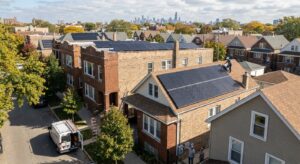
A residential solar installation in the Chicago area is a one to two day job for a professional crew. Here is what that actually involves.
First, the panels are mounted on racking hardware attached directly to your roof rafters — not just the sheathing. The mounts are flashed and sealed to prevent water intrusion. Then the panels are wired together and connected to the inverter, which is typically mounted near your electrical panel in the garage or utility room. The inverter connects to your electrical panel, and the system is complete from a hardware standpoint.
After installation, your system can’t go live immediately. It needs to pass a municipal inspection and receive interconnection approval from ComEd. Windfree handles both of those processes — the permit application, the inspection scheduling, and the ComEd paperwork — so the homeowner never has to coordinate any of it directly. From signed contract to live system, the typical timeline in the Chicago area is three to four months.
Once the system is live, you’ll have access to a monitoring app that shows real-time and historical production data. You can see exactly how much electricity your panels produced today, this month, and over the life of the system.
The Financial Picture in Plain Terms
The economics of solar come down to one comparison: what you pay for the system versus what you would have paid for electricity over the next 25 years without it.
On that comparison, solar wins for the vast majority of Chicago homeowners with reasonable roof access and ComEd service. The monthly savings start immediately when the system goes live. Illinois adds a meaningful incentive through the Illinois Shines SREC program, which pays homeowners for the renewable energy their system produces. And the U.S. Department of Energy notes that solar consistently adds value to residential properties.
Most Chicagoland homeowners who go solar see their monthly ComEd bill drop significantly. Panels are warrantied for 25 years and typically continue producing beyond that. The SREC payment arrives 12-18 months after installation and provides a meaningful return on top of the monthly savings.
The specific numbers depend entirely on your roof, your usage, and your system design. No two homes are identical. That’s why the starting point for any serious financial conversation is a site assessment that runs the actual numbers for your property.
Frequently Asked Questions
How many solar panels does a typical Chicago home need?
Most Chicago-area homes use between 8,000 and 12,000 kilowatt-hours of electricity per year. A system to offset most of that usage typically ranges from 6 to 12 panels depending on panel wattage, roof space, and production potential. Your installer will size the system based on your actual ComEd usage history, not a generic estimate.
Do solar panels require a lot of maintenance?
Very little. No moving parts means almost nothing to maintain. Most homeowners never do anything to their panels after installation. Occasional rain clears most surface dust naturally. If you notice a significant and sustained drop in production through your monitoring app, that’s worth calling your installer about — but routine maintenance is not part of the ownership experience for most people.
What happens during a power outage?
A standard grid-tied solar system shuts down automatically during a power outage. This is a safety requirement — the system stops sending electricity to the grid to protect utility workers doing repairs. If you want power during an outage, you need battery storage paired with your system. Battery storage adds backup capability and changes how your system behaves when the grid goes down.
Will solar panels damage my roof?
Installed correctly by a licensed contractor, solar panels don’t damage roofs — they actually protect the portion of the roof they cover from weather exposure. Before any installation, your installer should assess your roof condition to confirm it can support a system. Windfree evaluates roof condition as part of every site assessment and will flag any issues before installation begins.
How long until solar pays for itself?
Payback period depends on system cost, your ComEd usage, available incentives, and your financing arrangement. For most Chicagoland homeowners using Illinois Shines SREC incentives and ComEd net metering, payback typically falls somewhere between six and twelve years. With a 25-year panel warranty, that leaves well over a decade of effectively free electricity after break-even.
Is my roof suitable for solar?
Most Chicago-area homes are suitable. South, southwest, and west-facing roof sections with minimal shading are ideal. Flat or low-pitch roofs can work with the right racking. The only way to know for certain is a site assessment — a good installer will tell you honestly if your roof isn’t a strong candidate, because installing on a poor solar site doesn’t serve anyone.
What size system do I need?
System sizing is based on your annual electricity usage, your roof’s production potential, and your goals. Your ComEd bill history is the starting point. Bring twelve months of bills to your site assessment and your installer can size a system accurately from there.
Ready to See What Solar Looks Like for Your Home?
Understanding how solar works is the first step. The second is knowing what it looks like for your specific roof, your specific usage, and your specific financial situation.
Windfree Solar has been installing in Chicago and across Illinois since 2009. Over 600 installations. NABCEP certified. We handle every permit, ComEd interconnection application, and Illinois Shines enrollment in-house — the homeowner never has to manage any paperwork directly.
A free site assessment takes about an hour and gives you a real proposal with real numbers: production estimates for your roof, your projected SREC payment, your expected monthly savings, and a payback timeline. No pressure. No obligation.