If you own or manage a building in Illinois and you are weighing solar panels for your business, the first question is usually price. The more useful first questions are about the building, the project team and the calendar, because those decide what a commercial system can be and when it can start producing.
This guide walks through what an Illinois commercial solar project actually involves: how to tell whether your site is a fit, how solar fits into a new build or an existing building, the labor and contracting choices that come up early, the federal deadline that now shapes commercial timelines, and the steps from bid to permission to operate. Windfree Solar has been designing and building solar in Illinois and the Midwest since 2009, for building owners, general contractors and electricians alike.
Summary
- Solar is custom. Sun exposure, roof type, electrical service and how the building uses power shape a commercial system, not square footage alone.
- On a new build, solar is the last trade in physically but should be contracted at the beginning. The overall timeline runs 10 to 18 months from bid to permission to operate.
- Illinois solar incentives come with specific labor rules, and the contracting structure (owner-direct, through the general contractor or through the electrical contractor) is settled early.
- The federal credit for commercial solar is now time-gated. A project that began construction after July 4, 2026 must be placed in service by December 31, 2027 to qualify.
- Whether you sell or keep your system’s renewable energy credits changes what you can say about the building’s energy.
Is Your Building a Good Fit for Solar?
Solar is custom, so no average answers the question for a specific building. A handful of factors decide what a commercial system can look like:
- Sun exposure. Shade from neighboring buildings, trees or rooftop equipment affects output, so a large roof is not automatically a productive one. The site itself matters: a better site produces a better return.
- Roof type and condition. Pitched metal roofs and flat roofs take different mounting approaches. On the right roof, clip-on attachments for standing seam metal and ballasted racking for flat sections can avoid roof penetrations entirely.
- Electrical service. Where the system ties into the building, and the route the conduit takes to get there, are part of the design from the start.
- How the building uses power. When and how much electricity the building draws over the day and across the year shapes how the system is sized.
- Utility territory. ComEd and Ameren each run their own interconnection process. Our guide to ComEd solar versus Ameren solar explains how your utility shapes the project.
New Build or Existing Building
New Construction
On a new building, solar is the last trade in physically, but it should be contracted at the beginning. We can physically install faster, but the best results come when we are involved from day one so everything is coordinated around the build sequence.
We work from architectural plans and respect design intent. When specs call for products that are outdated, discontinued or unavailable, we identify the closest viable alternatives and coordinate approvals, so the vision becomes a buildable, warrantable reality. If you already know you want solar on your new building, our job is to deliver a gold-standard system and keep the process smooth for the entire project team.
Existing Buildings
Windfree also builds commercial solar on existing buildings. A retrofit works with the roof, the electrical service and the site the building already has, and roof attachments are coordinated with the roofer so the roof warranty is respected. Our post on solar for hotels covers how retrofit work gets sequenced around a building that stays open.
What Goes Wrong When Solar Comes in Late
Most of the friction on a commercial solar project comes from the gap between when solar is contracted and when it is installed. These are the issues we plan for on every new build:
- Labor and incentive compliance. Union and prevailing wage requirements are often not well understood until they become a problem. We ask the right questions up front.
- Product availability versus specs. Drawings often call for equipment that is outdated or discontinued by the time the job breaks ground. Early spec review and approved equivalents address that before it reaches the field.
- Crane and site access. Landscaping may already be finished by the time the array arrives. Access needs get flagged before finishes go in.
- Conduit and interior routing. Solar conduit is easy to treat as an afterthought. Runs are planned during rough-in, while the walls are still open.
- Roof attachments and warranties. We coordinate with the roofer during installation and use non-penetrating solutions where possible.
- Utility interconnection. ComEd and Ameren interconnection takes time. Windfree handles all of the utility back and forth and commissions the system through to permission to operate.
Labor Rules and Contracting Structure
Solar incentives in Illinois come with very specific labor rules. Project teams should not have to become experts in solar labor compliance; that is our job. Windfree works with both union and non-union crews and confirms which labor requirements apply at the bid and contract stage.
Windfree is an engineering, procurement and construction (EPC) firm, which is what qualifies us for public and municipal solar work. We also work within whatever contracting structure fits the project: owner-direct, through the general contractor, or through the electrical contractor.
The Federal Credit for Commercial Solar Now Has a Deadline
For commercial projects, the federal Investment Tax Credit (ITC) for solar, commonly 30% of the qualified investment, remains available, with a deadline attached. Under the One Big Beautiful Bill Act (OBBBA), enacted in 2025, eligibility now depends on when construction began. The IRS set out the rules in Notice 2025-42.
- Construction began on or before July 4, 2026: the project is not subject to the new termination date. The IRS continuity safe harbor generally gives it until the end of the fourth calendar year after construction began to be placed in service.
- Construction began after July 4, 2026: the system must be placed in service by December 31, 2027 to qualify.
For a business starting a project today, that means the calendar matters as much as the design. A new build with a 10 to 18 month timeline from bid to permission to operate has to be planned with that date in view.
Nonprofits and government entities can use elective pay, sometimes called direct pay, to receive the value of the credit as a payment from the IRS.
How any credit applies to your organization depends on your tax situation. Check with your tax advisor. We don’t give tax advice.
Selling or Keeping Your Renewable Energy Credits
A solar system generates renewable energy credits (RECs) along with electricity. Illinois Shines, the Adjustable Block Program administered by the Illinois Power Agency, is a state incentive that supports solar PV development through the purchase of RECs. If your application to the program is successful, your system will be part of Illinois Shines. Windfree Solar is an Approved Vendor under the Illinois Shines program.
There is a real decision here. If the RECs are sold, they help keep the cost of the system affordable, but the building cannot then claim to run on renewable energy. If they are retained, the owner keeps that claim. Heartland Community College retained its RECs so its new building could reach net zero, rather than selling them. That choice is worth making deliberately at the design stage.
From Bid to Permission to Operate
On a new build, the overall timeline runs 10 to 18 months from bid to permission to operate (PTO), the utility’s approval to switch the system on. The work moves through five phases:
- Concept and design. Solar layout, structural review and electrical concepts.
- Bid and contract. Labor requirements and incentive strategy are confirmed.
- Construction coordination. Conduit, crane access and the roof membrane are scheduled.
- Solar installation. Racking, modules and inverters go in, with the roof and finishes protected.
- Commissioning. Testing, inspections and permission to operate from the utility.
What This Looked Like at Heartland Community College
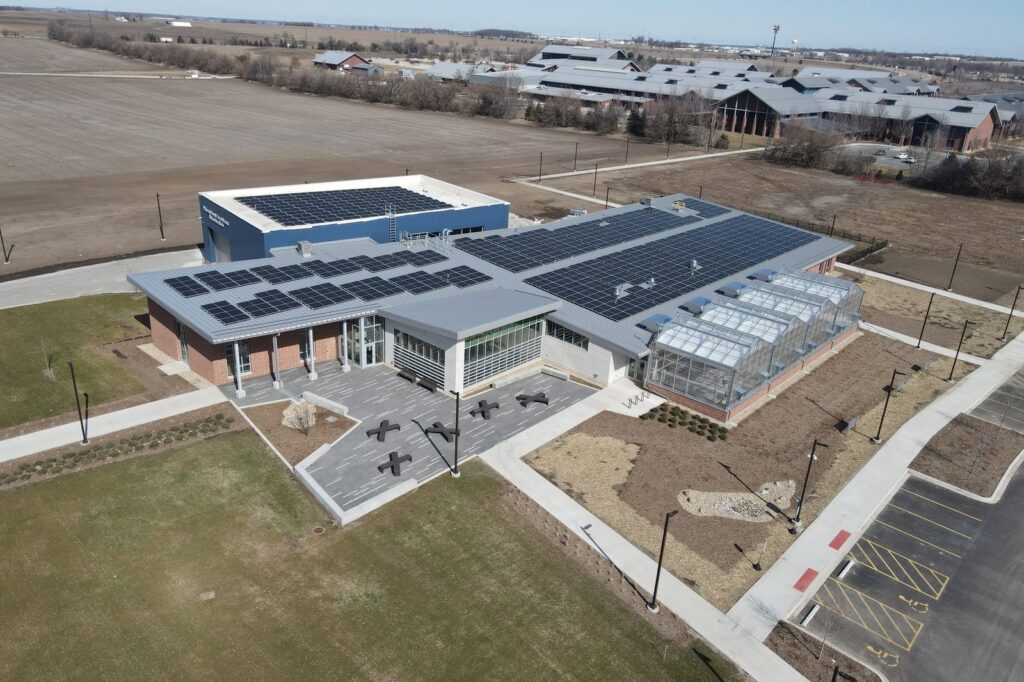
Heartland Community College’s Net Zero Agricultural Building in Normal, Illinois, in Ameren territory, carries a 216 kW rooftop array. Windfree delivered it through the electrical contractor as the design-assist and turnkey installer, with an IBEW union installation.
- About 75% of the array sits on a pitched standing seam roof with clip-on attachments, and about 25% on a flat roof with fully ballasted racking. There are zero roof penetrations across the entire array.
- The staggered, diagonal layout matched the architect’s design intent.
- Midway through the project, the work pivoted from a non-union crew to a union crew. The crew remobilized in about one to two weeks, and the project stayed under budget and on schedule.
- The building achieved net zero status, with no roof warranty conflicts.
The full story is in our Heartland Community College case study.
Working With Windfree Solar
Windfree Solar has installed 1,200+ systems across Illinois and the Midwest since 2009. We are a Certified Minority Owned Business (MBE) and an Equity Eligible Contractor (EEC), and our commercial clients include Turano, Guinness, Revolution Brewing and Heartland Community College. You can see more of the work, including the Obama Presidential Center Athletic Center, DePaul University and Somonauk High School, on our projects page.
We are also a Solar Insure certified provider, which not every installer can be. On qualifying systems that means a 30-year warranty covering equipment and labor.
Frequently Asked Questions
How early should we bring Windfree into a new building project?
At the beginning. Solar is the last trade in physically, but structural review, conduit routing, crane access and roof attachment details are all decided much earlier. Bringing us in at the concept stage lets us shape those decisions instead of working around them.
Will a solar installation affect our roof warranty?
We coordinate with your roofer during installation and use non-penetrating mounting where the roof allows it. On the Heartland Community College project, the full 216 kW array went in with zero roof penetrations and no roof warranty conflicts.
Our project has union or prevailing wage requirements. Can you work within them?
Yes. Windfree works with both union and non-union crews and asks about labor requirements up front. On the Heartland Community College project, when the work moved to a union crew partway through, the crew remobilized in about one to two weeks and the project stayed on schedule.
Can you work through our general contractor or electrician?
Yes. We work owner-direct, through the general contractor, or through the electrical contractor, whichever structure fits the project.
We are a nonprofit. Can we benefit from the federal credit?
Nonprofits and government entities can use elective pay to receive the value of the credit as a payment from the IRS, subject to the same construction and placed-in-service dates as any other commercial project. Check with your tax advisor. We don’t give tax advice.
Talk Through Your Project
Every building is different, and solar is custom. If you are planning a new build or looking at solar for an existing building, contact Windfree Solar, email our commercial team at sales@windfree.us, or call 312-588-6953, and we will walk through your site, your timeline and your project team.