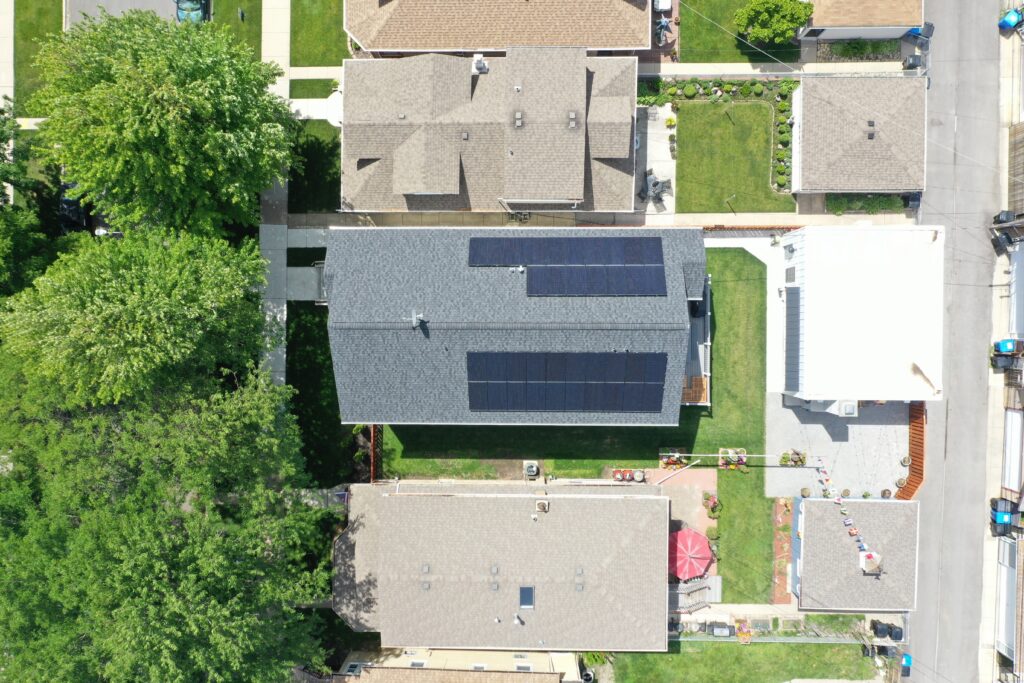
You’ve seen the ads. You’ve heard the buzz. Maybe your neighbor just got solar panels, or you’ve been noticing more roofs in your Chicago suburb with shiny blue-black panels catching the afternoon sun.
So you did what anyone would do: you grabbed your phone and typed some questions into Google.
“Will the state of Illinois pay for solar panels?”
“How do I qualify for free solar panels in Illinois?”
“Solar Illinois cost calculator”
“Why is my electric bill so high if I have solar?”
Good questions. Smart questions. Because here’s the thing about solar—it’s a major investment, and the landscape of incentives, programs, and rules changes faster than most people realize. What worked for your neighbor two years ago might not be the best option today. What you read on a national solar blog might not apply to Illinois at all.
At Windfree Solar, we’ve been installing systems across Chicagoland for over 15 years. We’ve watched incentives come and go. We’ve helped thousands of homeowners navigate the exact questions you’re asking right now.
And we’ve built a free solar calculator right on our website so you can see—instantly—what solar might look like for your home.
So let’s answer them—clearly, honestly, and with zero fluff.
Will the State of Illinois Pay for Solar Panels?
The short answer: Illinois won’t cut you a check labeled “free solar panels.” But the state has created a patchwork of programs that, when combined, can bring your out-of-pocket cost to zero or close to it.
First, Let’s Clear Up the Federal Tax Credit Confusion
Important update: The federal 30% tax credit that many people still ask about expired on December 31, 2025, for residential and commercial owned systems. It is no longer available.
You may still see old articles or outdated websites mentioning it. Ignore them. That credit is gone.
However, if you sign a lease or Power Purchase Agreement through programs like Illinois Solar for All, your installer can still capture business-related tax incentives and pass those savings to you in the form of lower monthly payments. But as a homeowner, you will not receive a direct tax credit.
We mention this because transparency matters. Some companies still advertise “30% off!” based on outdated information. Windfree Solar tells you what’s actually available right now.
Illinois Solar for All (ILSFA) – The Zero-Upfront Option
This is the closest thing to “free solar” in Illinois. Designed for income-eligible homeowners, ILSFA covers the cost of installation in exchange for you signing a long-term agreement to purchase the power the panels produceat a steep discount.
How it actually works:
You don’t own the panels. A solar developer installs them on your roof at no cost to you. You then enter either:
A Solar Lease: You pay a fixed monthly fee, locked in below your current electric bill average
A Power Purchase Agreement (PPA): You pay for the electricity the panels generate at a reduced per-kilowatt-hour rate, typically 30-50% less than ComEd charges
The critical detail most people miss: Your monthly payment under either option is capped at 50% or less of the value of the energy produced. So if your panels generate $100 worth of electricity in a month, you pay no more than $50. You start saving immediately, from day one.
Who qualifies? Your household income must be at or below 80% of the Area Median Income (AMI) for your county.
Here’s what that looks like in real numbers:
Household Size Cook County (80% AMI) DuPage County (80% AMI) Will County (80% AMI)
- 1 person $65,300 $69,100 $63,950
- 2 persons $74,600 $78,950 $73,100
- 3 persons $83,950 $88,800 $82,250
- 4 persons $93,250 $98,650 $91,350
If your income falls below these thresholds, you qualify. And here’s the kicker: ILSFA doesn’t care about your credit score. The program is designed specifically to make solar accessible to households that traditional financing might exclude.
Illinois Shines – The Upfront Payment Program
For everyone else, there’s Illinois Shines. This program creates a market for Solar Renewable Energy Credits (SRECs) basically, the environmental value of the clean energy your panels produce.
Here’s how it works in plain English:
For every megawatt-hour of electricity your solar panels generate, you earn one SREC. Illinois requires utility companies to buy these credits to meet state renewable energy goals. When you install solar, you can sell your future SRECs up to 15 years’ worth for a lump sum payment today.
What’s that worth? For a typical 8kW residential system in ComEd territory, you’re looking at approximately $7,000-$9,000 in upfront SREC payments.
Some installers handle this by:
- Cutting you a check after installation
- Reducing your upfront system cost by the SREC value (most common)
- Applying it as a credit toward your loan or lease payments
The program operates in “blocks” that fill up over time. As each block fills, the payment per SREC drops slightly. Block 6 is currently active, with payments around $78 per SREC. Earlier blocks paid more; future blocks will pay less. This creates a built-in incentive to act sooner rather than later.
Cook County Sun and Save – The Overlooked Gem
If you live in Cook County and your income falls between 80% and 120% of AMI, you may qualify for a program most people don’t know exists: Sun and Save.
This initiative covers 100% of installation costs plus any necessary roof repairs and electrical panel upgrades—the two biggest hidden costs that derail many solar projects.
Real example: A homeowner in Oak Park needed a new electrical panel before solar installation. That’s typically a $2,000-$3,000 unexpected expense. Sun and Save covered it. Their roof had some worn shingles that would have needed replacement within 5 years anyway. Sun and Save covered that too.
The program runs through August 31, 2026, but funds are limited and allocated on a first-come basis. If you’re in Cook County and your income falls in that middle band, this is worth checking immediately.
The ComEd Distributed Generation Rebate
Every new solar customer in ComEd territory gets a one-time rebate: $300 per kilowatt of system capacity. For that typical 8kW system, that’s $2,400—applied as a credit after your system is interconnected and producing.
This isn’t widely advertised, but it’s automatic. Your installer handles the paperwork, and you’ll see the credit on a future bill or as a direct payment.
How Do I Qualify for Free Solar Panels in Illinois?
Let’s be precise about what “free” means in solar context.
The Income-Qualified Path (ILSFA)
If your income is under 80% AMI, “free” means $0 out-of-pocket installation with immediate savings on your electric bill.
Here’s the exact process:
Step 1: Verify Your Income
Use the Illinois Solar for All website’s Income Lookup Tool. Enter your county and household size. You’ll get an instant yes/no on eligibility.
Step 2: Find an Approved Vendor
Not every solar installer can do ILSFA work. You need a company approved by the program administrator. Windfree Solar is an approved vendor. We handle the entire process.
Step 3: Site Assessment
We visit your home to evaluate:
- Roof orientation and tilt
- Shading from trees or nearby buildings
- Roof condition (should have at least 10-15 years of life left)
- Electrical panel capacity
Step 4: Contract Signing
If your site qualifies, you’ll sign a lease or PPA agreement. Critically, you’ll review and sign a “Solar Savings Estimate” that shows exactly what your monthly payments will be and how they compare to your current ComEd bills.
Step 5: Installation and Activation
We install the system, handle all permits and inspections, and get it connected to the grid. You start saving the day it goes live.
The Zero-Down Path for Everyone Else
Even if you don’t qualify for ILSFA, you can still get solar with zero money out of pocket through standard solar leases or PPAs offered by most reputable installers.
The difference is subtle but important:
- Feature ILSFA Lease/PPA Standard Lease/PPA
- Monthly payment cap 50% of energy value No cap, but still below utility rates
- Income requirement Under 80% AMI None
- Credit check Usually not required Yes, credit matters
- Installer eligibility Program-approved only Any installer
With a standard $0-down lease or PPA, your monthly payment is still lower than what you were paying ComEd. You just don’t have the hard cap that ILSFA provides.
The “Free Solar” Scams to Avoid
Let’s talk about the ads you see on Facebook and Instagram. “Get free solar panels from the government!” “Illinois solar stimulus program!” “Last chance for free installation!”
These are almost always misleading at best, predatory at worst.
Legitimate solar companies don’t need to promise “free” in giant red letters. They explain the programs clearly and let the numbers speak for themselves.
Red flags to watch for:
High-pressure sales tactics (“This price expires today!”)
Vague contracts that don’t clearly state your monthly obligation
Escalator clauses hidden in fine print (some leases increase payments 3-5% annually)
Transfer difficulties if you sell your home (some contracts make it hard for new buyers to take over)
Maintenance loopholes where you’re responsible for repairs you can’t perform
A trustworthy solar company provides clear contracts, transparent pricing, and honest explanations of what you’re signing.
Solar Illinois Cost Calculator: What Will You Actually Pay?
Let’s move from theory to numbers. Here’s what solar actually costs in Illinois right now.
Use Windfree’s Free Solar Calculator
Before we dive into averages, here’s the best way to get answers specific to your home:
👉 Try Windfree Solar’s Online Calculator
- In just 2 minutes, you’ll get:
- Estimated system size for your home
- Projected annual savings
- Current incentive estimates
- Monthly payment options
- Payback timeline
It’s free, no sign-up required, and gives you personalized numbers based on your actual address and electricity usage not generic averages.
2026 Pricing Reality (For Reference)
Based on recent installations across Chicagoland, here are current price ranges (before incentives):
System Size Typical Annual Output Average Cost Range Ideal For
- 5 kW 6,250 kWh $14,000 – $16,000 Small homes, condos, low usage
- 7 kW 8,750 kWh $19,000 – $22,000 Average 2-3 bedroom home
- 9 kW 11,250 kWh $24,000 – $28,000 4+ bedroom, electric appliances
- 12 kW 15,000 kWh $32,000 – $38,000 Large homes, EV owners
- 15 kW 18,750 kWh $40,000 – $48,000 Very large homes, high consumption
Why the range? Pricing varies based on:
Roof complexity (steep pitches cost more to install safely)
Panel selection (premium panels cost more but produce more)
Inverter type (microinverters vs. string inverters)
Electrical panel upgrades (if needed)
The Incentive Stack – What Comes Off That Price
Let’s run a realistic example for a 9 kW system on a typical Chicago bungalow:
Item Amount
Gross system cost $26,000
Illinois Shines SREC payment -$7,500
ComEd DG rebate ($300/kW × 9) -$2,700
Net cost after incentives $15,800
That’s your actual out-of-pocket if you pay cash.
If you finance:
Loan Term Interest Rate Monthly Payment
10 years 4.99% $167
15 years 5.99% $133
20 years 6.99% $122
Compare that to the average ComEd bill in Illinois: $114-$140 per month. Even with financing, you’re in the same ballpark as your current utility bill—but you own the system and lock in your rate for decades.
The Payback Reality Check
Solar salespeople love to throw around “5-year payback!” numbers. In Illinois, with current rates and incentives, here’s the honest truth:
Scenario Payback Period
Cash purchase, average usage 10-12 years
Financed purchase, average usage 12-15 years (factoring interest)
Lease/PPA, no upfront cost Immediate savings, no payback period
The 25-year picture:
If that $15,800 system saves you $1,400 per year (based on current ComEd rates), your 25-year savings look like this:
Total electricity without solar: ~$35,000 (assuming 3% annual rate increases)
Total cost with solar: $15,800 + minimal fixed utility fees (~$8,000 over 25 years)
Net savings: $11,200+
And that’s conservative. If utility rates rise faster than 3%—which they have historically—your savings increase.
Why Is My Electric Bill So High If I Have Solar?
This is the question that drives new solar owners crazy. You invested in solar. Your panels are producing. So why isn’t your bill $0?
Let’s troubleshoot.
The 2025 Billing Rule Change
If you installed solar after January 1, 2025, you’re on Smart Solar Billing, not the old net metering system your neighbor might have.
Old system (pre-2025): Every kilowatt-hour you sent to the grid was credited at the full retail rate, supply AND delivery charges combined. This effectively let you bank credits at maximum value.
New system (2025+): You receive credits only for the supply portion of your excess electricity. Delivery charges are not credited. You also receive the one-time DG rebate we discussed earlier.
What this means for your bill: If you used to have a $20 credit balance under the old system, you might now have a $10 credit balance. Your bill isn’t higher it’s just not as low as you might have expected based on outdated information.
You’re Being Charged for What Solar Can’t Cover
Even with a perfectly sized system, you’ll always have some unavoidable charges:
Charge Type Why It Exists Typical Monthly Amount
Customer connection fee Covers grid maintenance, billing, infrastructure $15-$20
Delivery charges on grid usage You pay delivery when you pull from the grid at night Varies
Taxes on fixed fees Same taxes applied to any utility customer $5-$10
These add up to $25-$40 per month even if your panels cover 100% of your usage.
Your Usage Changed After Installation
This is incredibly common. You got solar, felt great about your lower bills, and then:
Bought an electric vehicle (doubling your electricity consumption)
Added a home addition
Installed a pool with electric heater
Started working from home permanently
Added central AC to a previously window-unit home
The fix: Review your annual true-up statement from ComEd. Compare your total production to your total consumption.
If you’re using more than you’re producing, you have three options:
Accept that you’ll have a partial bill and still save overall
Add more panels to your system (if your roof has space and your inverter can handle expansion)
Add battery storage to shift your solar production to evening hours when you need it
Performance Issues You Might Not Notice
Solar panels are reliable, but problems happen:
Inverter failure: The most common issue. Your monitoring app might show one array not producing. A red or blinking light on the inverter means it needs service.
Panel degradation: Normal aging loses about 0.5% efficiency per year. After 10 years, that’s only 5% not dramatic.
Soiling: Dust, pollen, bird droppings, and especially solar panel snow coverage can reduce output. In Chicago winters, panels covered by snow produce nothing until it melts or slides off.
Shading changes: That tree you loved 5 years ago now casts afternoon shade on your best array. Trimming may help.
The Seasonal Reality Check
Look at your bill in July. High, right? AC running hard, days long but so is consumption.
Look at your bill in February. Probably lower usage, but also lower production from short days and snow.
True savings show up annually. Your March true-up statement tells the real story. If you’re overproducing annually, you’ll get a check from ComEd. If you’re underproducing, you’ll pay the difference. One month doesn’t tell the whole story.
The Bottom Line – What You Actually Need to Know
Let’s bring it all together.
Question Straight Answer
Will Illinois pay for my solar?
Through ILSFA (income-qualified), Illinois Shines (SREC payments), ComEd rebates, and Sun and Save (Cook County), the combined value can bring your net cost to zero or near-zero.
Can I get free panels?
If you qualify for ILSFA or Sun and Save, you can get installed with $0 upfront and immediate savings. Otherwise, $0-down leases and PPAs offer a similar “no money out” experience.
What will it actually cost?
Use Windfree’s free solar calculator for personalized numbers. General range: $15,000-$40,000 gross, $10,000-$25,000 net after incentives, with 10-14 year payback for cash purchases.
Why is my bill still high?
New billing rules, fixed utility charges, increased usage, seasonal variation, or performance issues are the usual culprits.
Your Next Step – Get Your Personal Numbers
Every home is different. Every roof faces a different direction. Every family uses electricity differently.
The only way to know what solar looks like for your home is to get a customized assessment from an experienced local installer.
Start here:
👉 Try Windfree’s Solar Calculator – Get instant estimates in 2 minutes
👉 Schedule a Free Consultation – Talk to a real expert who knows Illinois programs inside and out
At Windfree Solar, we’ve been doing this in Chicago and the surrounding suburbs for over 15 years.
We know:
Which programs you qualify for based on your specific address and income
How to maximize your incentives without cutting corners
What realistic production looks like for your exact roof
How to structure financing, lease, or PPA options that actually make sense for your situation
Here’s what happens when you reach out:
Free consultation: We’ll discuss your goals, your current bills, and your questions
Site assessment: We’ll evaluate your roof and provide a production estimate
Custom proposal: You’ll see exactly what it costs, what you save, and how the numbers work
No pressure: You decide if it makes sense for you
👉 Contact Windfree Solar today for your free consultation.
👉 Visit our residential solar page to learn more.
Serving homeowners throughout Chicago, Naperville, Evanston, Oak Park, and all surrounding suburbs with professional solar installation backed by 15+ years of local experience.