
Key Takeaways
- Illinois doesn’t use traditional SRECs — instead, the Adjustable Block Program (Illinois Shines) offers fixed-rate REC contracts for 15 years
- Commercial solar systems earn annual performance-based payments on top of electricity savings and federal tax credits
- The full Illinois incentive stack can cover 50–70% of a commercial solar installation’s total cost
- REC values decline as program blocks fill up, which means waiting costs real money
- Working with an Illinois Shines Approved Vendor like Windfree Solar is required to participate
The Money Sitting on Your Roof That Nobody Told You About
Here’s something that still surprises most Chicago business owners when we bring it up: every kilowatt-hour your solar panels produce creates a tradeable financial instrument. It’s called a Renewable Energy Certificate — or REC — and in Illinois, the way you monetize that certificate is unlike almost any other state in the country.
If you’ve heard the term “SREC” thrown around and assumed Illinois works the same way as New Jersey or Massachusetts, you’re not alone. But Illinois carved its own path. And honestly? For commercial property owners, it’s a better deal than most open-market SREC programs could ever offer.
We’re going to walk through exactly how this works, what it means for your bottom line, and why the clock is ticking on current incentive levels.
SRECs vs. RECs: Why Illinois Does It Differently
In states with traditional SREC markets, solar system owners generate certificates and sell them on an open exchange. Prices bounce around based on supply and demand — sometimes you get a great price, sometimes the market craters and your expected revenue disappears. It’s a gamble disguised as a policy incentive.
Illinois took one look at that volatility and said no thanks.
Instead, the state created the Adjustable Block Program, which most people know by its consumer-facing brand: Illinois Shines. Administered by the Illinois Power Agency, the program sets REC prices administratively and locks them into 15-year contracts. No market speculation. No watching commodity prices before breakfast. Just a predictable revenue stream you can actually build a financial model around.
For a business owner trying to justify a six-figure capital expenditure to a board or partner group, that predictability changes the entire conversation.
How the Adjustable Block Program Actually Works
The ABP divides solar installations into categories based on system size and type. For commercial properties, you’re typically looking at the Large Distributed Generation track, which covers systems between 25 kW and 2 MW. That’s the sweet spot for warehouses, office buildings, retail centers, and manufacturing facilities across the Chicago metro. (If you’re curious about the financing side of commercial solar, we break that down separately.)
Here’s the mechanism: when you install a qualifying solar system through an Illinois Shines Approved Vendor, you enter into a contract with the IPA. You agree to assign your RECs to the state for 15 years. In return, the program pays you for every megawatt-hour your system produces — annually, based on actual generation data.
The “adjustable block” part refers to how pricing works. The program releases capacity in blocks. When one block fills up with enough applications, the next block opens at a slightly lower price — typically a 2–4% reduction. Think of it like stadium seating. The earlier you grab your spot, the better your view. Or in this case, the better your rate.
Small residential systems under 25 kW get their REC value as an upfront lump sum, which is nice for homeowners. But commercial systems get something arguably more valuable: a 15-year stream of annual performance payments that you can forecast, bank on, and use to strengthen your project’s internal rate of return.
What This Means in Real Dollars for Chicago Businesses
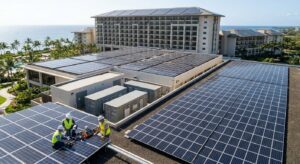
Let’s get concrete. A mid-size commercial installation — say a 200 kW rooftop system on a warehouse in Elk Grove Village or a distribution center near O’Hare — generates roughly 250–280 MWh per year in the Chicago climate. Your annual REC payment depends on which block you land in and when you applied, but the 15-year total can represent a significant chunk of the system’s installed cost.
Stack that on top of the other incentives available right now:
- Federal Investment Tax Credit (ITC): 30% of installed cost, with potential bonus credits pushing it to 40–50% under the Inflation Reduction Act for projects meeting prevailing wage, apprenticeship, or domestic content requirements
- MACRS depreciation: Five-year accelerated depreciation lets you write off the system’s value against taxable income faster than almost any other capital asset
- Net metering: ComEd credits your account at full retail rate for surplus electricity your system exports to the grid
- Property tax exemption: Illinois exempts the added value of solar equipment from property taxes for 30 years
- Sales tax exemption: The state’s 6.25% sales tax doesn’t apply to solar equipment purchases
When you add it all up, the combined incentive stack routinely covers 50–70% of total project cost for qualifying commercial installations. The REC payments from Illinois Shines are a critical piece of that puzzle — and they’re the piece most business owners either don’t know about or misunderstand because they’re Googling “Illinois SRECs” and finding outdated information about open-market trading. If you’re still getting a handle on the broader Illinois solar incentive landscape, that’s a great place to start.
The CEJA Factor: How Illinois Supercharged Its Solar Program
The Climate and Equitable Jobs Act, signed into law in 2021, fundamentally reshaped the state’s clean energy trajectory. Among a lot of ambitious policy, CEJA committed Illinois to 100% clean energy by 2050 and poured substantially more funding into the Adjustable Block Program.
What that means practically: more capacity blocks, new equity-focused participation tracks, and workforce development standards that create good-paying installation jobs across the state. The program’s Year 2 under the CEJA framework launched in March 2025, opening fresh capacity with updated pricing.
CEJA also brought in something called the equity eligible contractor track and expanded community solar options, making the program more accessible. But for straight commercial rooftop installations, the biggest impact is simple: there’s more money in the program and more political commitment behind it than at any point in Illinois history.
That political commitment matters. When you’re signing a 15-year contract, you want to know the program has legislative backing and long-term funding. CEJA provides that backbone.
Why Waiting Is the Most Expensive Decision You Can Make
Remember that stadium seating analogy? It’s not just a metaphor. Every time an ABP block fills and the next one opens, the REC rate drops. By design, the program rewards early adopters and gradually reduces incentives as the market matures.
We’ve watched this play out in real time. Business owners who came to us eighteen months ago locked in rates that are no longer available. The system they installed is identical to what you’d install today — same panels, same inverters, same rooftop. But their 15-year REC contract is worth more simply because they didn’t wait.
There’s also the federal side to consider. The 30% ITC is solid for now, but there’s ongoing political pressure around clean energy tax credits. Nobody can predict with certainty what happens after the next election cycle or the next budget fight. What we can tell you is that right now, today, the full incentive stack is the strongest it’s been.
Procrastination has a price tag. And it’s not a small one.
How to Get Started: The Approved Vendor Requirement
You can’t just install solar panels and start collecting REC payments on your own. The Illinois Shines program requires you to work with a registered Approved Vendor who handles the application, system qualification, and ongoing REC contract administration.
At Windfree Solar, we handle that entire process. We’ve guided commercial projects through the ABP from initial site assessment through energization and REC contract finalization. We know which blocks have capacity, we understand the application timeline, and we make sure your system is designed to maximize both energy production and REC value.
The process typically looks like this:
- Site assessment and system design based on your roof, your load profile, and your financial goals
- ABP application submitted through the Illinois Shines portal
- System installation and interconnection with ComEd
- Part I verification confirming the system meets program requirements
- 15-year REC contract activated, with annual payments flowing based on metered generation
From first conversation to activated contract, the timeline varies — but most commercial projects move from signed proposal to energized system in four to six months, depending on permitting and interconnection timelines in your municipality.
Frequently Asked Questions
Does Illinois have SRECs?
How much are RECs worth in Illinois for commercial solar?
Can I sell RECs on the open market instead of through Illinois Shines?
What is the Adjustable Block Program application timeline?
Do REC payments stack with the federal solar tax credit?
What happens to my REC contract if I sell my building?
Your Next Move
If you’ve been researching solar for your Chicago-area commercial property and the financial math hasn’t quite clicked yet, this might be the missing piece. The Illinois Shines REC payments turn a good investment into a great one — and every month you wait, the available rate ticks down as program blocks fill.
We’d love to run the numbers with you. Not a sales pitch — just a clear-eyed look at what your specific building, your energy usage, and the current incentive stack add up to. Request a quote from Windfree Solar and let’s see what your roof is worth.
Eric Heineman is a solar energy expert at Windfree Solar, helping businesses and homeowners across the Greater Chicago area harness the power of solar. With deep expertise in commercial and residential solar installations, Eric brings data-driven insights and a genuine passion for clean energy to every project.