Type your address into a free solar calculator and you’ll get a number in about eight seconds. The problem is that number is often wrong, sometimes by tens of thousands of dollars, because it doesn’t know what your roof looks like, which utility serves your address, or which Illinois incentives you actually qualify for. A real solar estimate takes more inputs than any online tool can gather on its own, and getting it wrong means either overpaying or under-sizing a system that’s supposed to last 25 years.
We build estimates for both homeowners and commercial project teams across ComEd and Ameren territory, and the gap between a calculator’s guess and a properly engineered proposal is usually significant. This guide walks through what actually drives an accurate number in 2026, whether you’re putting panels on a ranch house in Naperville or designing a 200-kW array for a new agricultural building downstate.
- Summary:
- Free calculators like PVWatts and Project Sunroof are great starting points but skip roof condition, shading detail, and local utility rate structures.
- ComEd and Ameren have different rate structures and interconnection processes, which change your payback math even for identical systems.
- A 2,000 sq ft Illinois home typically needs a 7-9 kW system, but roof orientation and shading can swing that by 20% or more.
- The federal residential credit under Section 25D does not apply to systems placed in service in 2026, so a homeowner estimate should not subtract 30% federally on a purchased system.
- Commercial projects need design-assist, not a calculator, because labor rules and incentive stacking (ITC, adders, rebates, SRECs) can cover a substantial share of project cost, and the federal piece is now gated by when construction began.
- The 33% rule and 20% rule are simplified sizing shortcuts, useful for a gut check, not for a final proposal.
Why Free Online Solar Calculators Get Illinois Estimates Wrong
Tools like PVWatts, Project Sunroof, and EnergySage’s calculator are genuinely useful; we use some of them ourselves during early conversations. But they all share the same blind spot: they estimate based on satellite imagery, average irradiance data, and self-reported utility rates. None of them can see the age of your roof, the exact pitch of a low-slope commercial membrane, or whether a tree two lots over throws a shadow across your south-facing array every afternoon in October.
Illinois adds another layer of complexity. Our incentive stack, federal, state, and utility-level, shifts constantly, and a generic calculator built for a national audience usually applies a flat, outdated assumption about state rebates. We wrote a deeper breakdown of this in our piece on whether solar calculators are accurate, and the short version is: they’re a fine napkin-math starting point, not a number you should sign a contract against.
Free Tools vs. a Real Site Assessment
PVWatts, built by the National Renewable Energy Laboratory, is the gold standard for production modeling, but it requires you to manually input system size, tilt, and azimuth. It won’t tell you what size system you need or catch a shading issue unless you already know to look for one. Project Sunroof leans on Google’s imagery to auto-detect roof planes, which struggles with complex commercial rooflines or standing seam metal roofs. EnergySage’s calculator does a decent job estimating cost ranges, but it’s built to generate marketplace leads, not a locked, warrantable number.
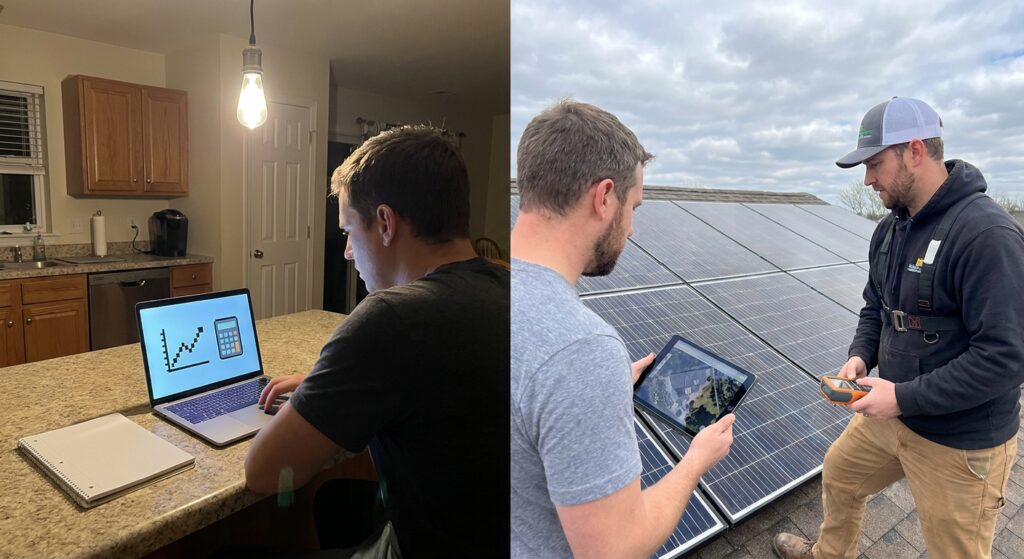
A real site assessment adds what none of these tools can: a technician or design-assist engineer physically reviewing the roof structure, electrical panel capacity, shading obstructions at different times of year, and interconnection requirements specific to your utility. That’s the difference between an estimate and a proposal you can actually build from.
What Actually Goes Into an Accurate Solar Estimate
An accurate number starts with your actual energy usage, usually 12 months of utility bills, layered against your roof’s real-world solar potential. From there, we factor in equipment availability, local permitting requirements, and whichever incentives apply to your specific property and ownership structure. Skipping any one of these variables is exactly how homeowners end up with undersized systems, or commercial teams end up with bids that fall apart during permitting.
Roof Type, Shading, and Orientation
Roof type changes both cost and production. A simple asphalt shingle roof in good condition is cheapest and fastest to work with. Standing seam metal roofs, like the one on the Heartland Community College project, allow clip-on, non-penetrating racking that protects the roof warranty entirely. Flat commercial roofs usually call for ballasted racking, which adds weight considerations but avoids penetrations too.
Shading is where a lot of DIY estimates fall apart. A single large tree, a neighboring building, or a rooftop HVAC unit can cut annual production by 10-15% if it’s not accounted for in the design. Orientation matters just as much, true south-facing arrays produce the most, but east-west split arrays can still make sense on commercial roofs where you’re maximizing usable area rather than chasing peak output.
Utility Territory Matters: ComEd vs. Ameren
Where your property sits, ComEd or Ameren territory, changes your estimate more than most people expect. Rate structures, net metering policies, and interconnection processing times differ between the two utilities, and both have gone through updates in recent years. We cover the ComEd side in detail in our net metering guide. If your calculator doesn’t ask which utility serves your address, its output shouldn’t be treated as a real number.
Residential Solar Estimates: What Illinois Homeowners Should Expect
For homeowners, an accurate estimate should include system size, all-in cost before incentives, net cost after any Illinois Shines value, and a realistic annual production number tied to your actual usage, not a generic state average. It should also disclose financing terms clearly if you’re not paying cash, since a low monthly payment can mask a system priced well above market.
We go deep on 2026 pricing specifics in our Chicago solar cost breakdown, but the short version: expect meaningful variation based on roof complexity, sun exposure, electrical panel upgrades, and whether you’re adding battery storage.
How Much Is a Solar System for a 2,000 Sq Ft House?
A typical 2,000 square foot Illinois home uses somewhere around 800-1,000 kWh per month, which usually calls for a 7-9 kW system depending on roof orientation and shading. At current Illinois pricing, that generally lands in a broad range before incentives. One important correction for 2026: the federal residential credit under Section 25D applied to systems placed in service through December 31, 2025 and does not apply to systems placed in service in 2026, so an estimate for a system you are buying should not subtract 30% federally. The test was completed installation rather than payment date, so a deposit paid in 2025 on a system installed in 2026 does not qualify either. Illinois Shines value and net metering are what shape the net number now. Windfree does not give tax advice, so confirm your own situation with your tax advisor. The final number swings based on roof pitch, whether a panel upgrade is needed, and how much shading the site has, which is exactly why a phone-based quote or a satellite-only calculator can be off by a full kilowatt or two in either direction. A site visit with actual shading analysis is the only way to get a number you can trust.
Commercial Solar Estimates for New-Build and Retrofit Projects
Commercial estimating works on a completely different level of complexity than residential. You’re not just sizing panels against usage; you’re coordinating with architectural plans, structural engineers, electrical contractors, and often union labor requirements, all before a single panel gets ordered. For new-build projects specifically, the solar estimate needs to be locked in early enough to influence conduit routing, roof penetration planning, and crane access, not bolted on after the building is already framed.
Commercial specs often call for equipment that’s outdated, discontinued, or simply unavailable by the time construction starts. A calculator has no way to flag that. Design-assist means reviewing architectural plans early, identifying approved equivalents when needed, and coordinating labor compliance, union vs. prevailing wage requirements trip up a lot of project teams who assume solar labor rules work like every other trade’s. On the Heartland Community College project, a mid-project labor pivot from non-union to union crew was absorbed and remobilized in about 1-2 weeks without blowing the budget or schedule, precisely because the estimate and design process had built in that flexibility from day one.
Illinois Solar Incentives That Change Your Estimate
Incentives are the single biggest reason a generic online calculator produces a misleading number for Illinois properties. The state’s incentive stack is genuinely one of the more generous in the country, but only if you know which pieces apply to your project.
For a typical 200-220 kW commercial project, the stack can include the 30% federal Investment Tax Credit, a 10% Energy Community Adder (which applies to roughly 85% of Illinois sites), a utility rebate of around 10% from ComEd or Ameren, and additional value from selling Solar Renewable Energy Credits through the Illinois Power Agency’s Adjustable Block Program. The federal piece is not open-ended. Under the One Big Beautiful Bill Act, commercial projects that began construction before July 4, 2026 are safe harbored with up to four years to be placed in service, while projects beginning construction after that date must be placed in service by December 31, 2027. Which side of that line your project falls on changes the estimate materially, and it is another thing no calculator will ever ask you. Some organizations, like Heartland Community College, choose to retain their RECs for net zero certification rather than monetize them, a legitimate strategic choice that changes the ROI math.
On the residential side, the current picture is covered in our breakdown of what changed for Illinois homeowners on June 1 and in our honest read on whether solar is worth it in Illinois in 2026. The federal Database of State Incentives for Renewables & Efficiency is also a solid reference for confirming current program details.
How to Tell If a Solar Estimate Is Legit
A legitimate solar estimate should always include a few non-negotiables: actual utility bill data (not just a zip code average), a site-specific shading analysis, a clear breakdown of equipment brands and warranties, and incentive figures that match the current Illinois Standard Disclosure Form. If a proposal promises guaranteed savings without a contractual savings guarantee, or claims your home will “run on clean energy” while also planning to sell your RECs, that’s a compliance red flag under Illinois Shines marketing rules, not just a style issue.
Be wary of any estimate that arrives instantly with no questions asked about your roof age, shading, or panel capacity. Also be cautious of quotes that use “free solar” language unless the system is genuinely no-cost to you. A real proposal takes time to build because it’s actually built around your property, not a template.
The 33% Rule and the 20% Rule, Explained
You’ll sometimes hear installers reference the “33% rule” and the “20% rule” as quick sizing shortcuts. The 33% rule suggests sizing a system to offset roughly 33% higher usage than your current consumption, giving room for future electrification, think EV charging or a heat pump added down the road. The 20% rule is a related shortcut some installers use to estimate that a home needs to dedicate about 20% of usable roof area to solar to meaningfully offset typical household usage.
Both are useful for a quick gut-check, but neither replaces an actual usage analysis. If your household is planning a major electrical change in the next few years, an EV, a pool heater, an addition, that needs to be built into the real number, not estimated with a rule of thumb. We touch on this planning angle in our kilowatt-hours explainer, which is worth a read if the unit itself is still a little fuzzy.
How Windfree Builds a Real Solar Estimate
Our process starts the same way for a homeowner in Oak Park and a general contractor breaking ground on a net-zero facility: we gather real data before we model anything.
- Usage review: 12 months of utility bills or, for new construction, projected load calculations from the electrical engineer.
- Site or plan review: A physical site visit for existing buildings, or a review of architectural and structural plans for new builds, including roof material, pitch, and any specified equipment.
- Shading and production modeling: Using tools like PVWatts as a baseline, cross-checked against actual site conditions and seasonal shading patterns.
- Labor and incentive strategy: Confirming union or prevailing wage requirements, then mapping the full incentive stack, ITC, adders, rebates, SRECs, against your specific project type.
- Final proposal: A locked system size, itemized cost, incentive breakdown, and production estimate you can actually take to a bank, a board, or a spouse.
For new-build commercial projects specifically, we push to get involved during the concept and design phase, not after conduit is already poured, because that’s when the estimate actually holds up through construction.
Frequently Asked Questions
How much is a solar system for a 2,000 sq ft house?
Most 2,000 sq ft Illinois homes need a 7-9 kW system based on typical monthly usage of 800-1,000 kWh. Final pricing depends on roof condition, shading, and whether a panel upgrade is needed. Note that the federal residential credit does not apply to systems placed in service in 2026, and completed installation rather than payment date was the test, so the net cost of a purchased system now rests on Illinois Shines value and net metering. A site-specific quote is the only way to get an exact number.
Is a solar estimate legit?
A legitimate solar estimate is grounded in your actual utility usage, a real shading and roof analysis, and incentive figures that match Illinois’ Standard Disclosure Form. Be skeptical of instant online numbers with no site data, guaranteed savings claims without a contractual guarantee, or “free solar” language when the system isn’t genuinely no-cost.
What is the 33% rule in solar panels?
The 33% rule is a sizing shortcut suggesting a solar system should be built to offset about 33% more energy than current usage, leaving headroom for future additions like an EV charger or heat pump. It’s a helpful planning heuristic, not a substitute for a real load analysis.
What is the 20% rule for solar?
The 20% rule is a rough guideline some installers use, suggesting roughly 20% of a home’s usable roof area needs to be dedicated to solar panels to meaningfully offset typical household electricity usage. Actual roof allocation depends heavily on panel efficiency and roof shape.
Why did my online solar quote come in so much lower than a company’s actual proposal?
Online calculators often use average pricing and don’t account for your roof’s specific condition, shading, or your utility’s interconnection requirements. Once a real site assessment happens, the number typically shifts to reflect actual equipment, permitting, and labor costs specific to your property.
Do commercial solar estimates take longer than residential ones?
Yes, generally. Commercial estimates require coordination with architectural plans, electrical engineers, and sometimes union labor scheduling, which residential quotes don’t need. A commercial estimate for a new-build project can take several weeks to finalize properly, especially if design-assist is involved.
Can I trust a solar estimate that promises guaranteed savings?
Only if the guarantee is written explicitly into your contract. Under Illinois Shines marketing rules, vendors cannot claim guaranteed savings unless that guarantee is contractual, so a verbal promise or a vague marketing claim isn’t enforceable and should raise questions.
Getting a solar estimate right isn’t about finding the fastest calculator; it’s about finding the one that actually looks at your roof, your utility territory, and your incentives before putting a number in front of you. Whether you’re a homeowner comparing your first quote or a GC coordinating a net-zero build, Windfree Solar builds estimates from real site data, not satellite guesses. Reach out and we’ll walk your specific property or project through the numbers.