Picture this: it’s 2:47 PM on a sweltering August Tuesday in Chicago. Your warehouse in Elk Grove Village is humming — forklifts moving pallets, refrigeration units keeping inventory cold, the office AC fighting a losing battle against the heat. Then everything stops. The grid just… quit. No warning, no estimate for restoration. Your operations manager is already doing the math: spoiled product, idle workers, missed shipments. By the time ComEd gets things back online six hours later, you’ve lost somewhere north of fifteen thousand dollars.
This isn’t a hypothetical. Chicago businesses experienced more than 700 hours of power interruptions last year alone, according to utility reliability data — and that number has been climbing. Between aging infrastructure, more frequent extreme weather, and a grid that was designed for the 20th century, the question isn’t if your business will face a costly outage. It’s when.
But here’s what’s changing the conversation: the same solar panels that cut your electric bill can also keep your lights on when the grid fails. Add battery storage, and you’re not just saving money — you’re building a business that keeps running, no matter what happens down the line. At Windfree Solar, we’ve spent years helping Chicago businesses think beyond just solar panels — and lately, the conversation has shifted hard toward resilience. Let’s talk about why.
Key Takeaways
- Solar panels alone shut off during grid outages for safety — pairing them with battery storage is what keeps your business powered when the grid goes dark
- Commercial battery storage costs have dropped nearly 90% over the past decade, making solar + storage financially viable for mid-sized businesses, not just massive warehouses
- Illinois incentive programs — including Smart Inverter rebates and the Climate and Equitable Jobs Act provisions — can cover a significant portion of battery storage installation costs
- Energy resilience isn’t just about surviving outages — it’s increasingly a competitive advantage when clients and partners evaluate supply chain reliability
Why Solar Alone Isn’t a Backup Plan
Let’s clear up a common misunderstanding right away. If you have solar panels on your commercial roof and the grid goes down, your building still goes dark. This surprises a lot of business owners, and I get why — it feels counterintuitive. Your panels are still making electricity. The sun is still shining. So why isn’t anything working?
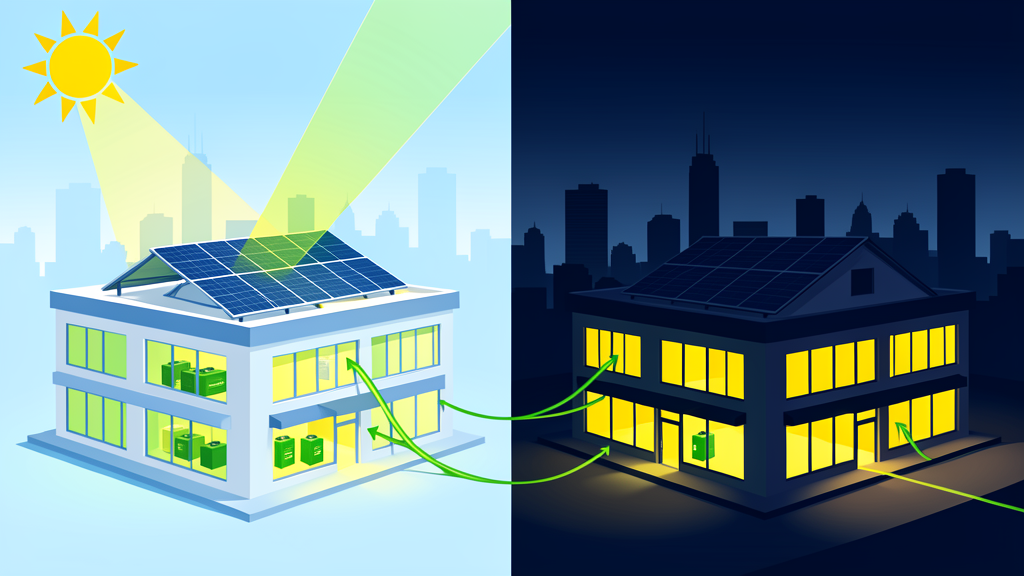
The answer is safety. Grid-tied solar systems are required to shut down during an outage so they don’t send power back into lines that utility workers are trying to repair. It’s a sensible regulation — nobody wants to electrocute a line worker — but it means your solar investment goes dormant exactly when you need it most. The missing piece is battery storage. When you add batteries, your solar system can island itself from the grid, continuing to generate and store power for your building while staying safely disconnected from the outside lines.
Think of it like this: solar panels are a faucet. A battery is a reservoir. Without the reservoir, you can only use water while the faucet is running — and the faucet shuts off automatically when the grid goes down. With the reservoir, you’re filling it during the day and drawing from it whenever you need to, grid or no grid.
How Islanding Actually Works
The technical term for what I’m describing is “islanding” — the ability of your solar + storage system to detect a grid outage, disconnect from the grid within milliseconds, and continue powering your building independently. Modern commercial battery systems from manufacturers like Tesla and Enphase handle this transition seamlessly. Your computers don’t reboot. Your refrigeration doesn’t cycle down. Your security system doesn’t blink. For most businesses, the switch is literally imperceptible.
The size of the battery determines what you can keep running and for how long. A modest battery setup might cover critical loads — servers, security, a few lights, refrigeration — for several hours. A larger system paired with robust solar generation can keep an entire facility running through a multi-day outage. The math is straightforward: your energy needs during an outage, multiplied by the duration you want to cover, equals your storage requirement. A good commercial solar partner helps you run those numbers with real utility data, not guesses.
The Economics Have Finally Caught Up
For years, the business case for commercial battery storage fell apart on price. Batteries were expensive — really expensive — and unless you were a data center where every second of downtime cost thousands, the ROI math didn’t pencil out. That has changed dramatically. Lithium-ion battery costs have fallen roughly 89% since 2010, according to BloombergNEF. What was a six-figure luxury a decade ago is now a five-figure investment with a clear payback period.
And the payback isn’t just about outage protection. In Illinois, commercial battery storage can generate revenue through a few different channels. ComEd’s time-of-use rates mean you can charge batteries when electricity is cheap (overnight, early morning) and discharge when rates spike (summer afternoons). That’s called peak shaving, and for businesses with demand charges on their utility bills, it can knock 20-30% off the monthly electric bill before you even factor in solar generation.
There’s also the federal Investment Tax Credit, which currently covers 30% of the installed cost of battery storage when paired with solar — and thanks to the Inflation Reduction Act, standalone storage now qualifies too. Stack Illinois-specific incentives on top — the Illinois Solar for All program and ComEd’s energy efficiency rebates — and the net cost starts looking a lot friendlier than most business owners expect.
What an Outage Really Costs
We tend to think about power outages in terms of inconvenience. But for a commercial operation, an outage is a compounding financial event. Let me walk you through what actually happens during a six-hour interruption at a typical mid-sized Chicago business.
First, the obvious costs: idle employees who still need to be paid, production that isn’t happening, shipments that aren’t going out. A manufacturing facility losing a full shift of production can easily burn $20,000 to $50,000 in a single afternoon. Second, the cascade: orders get delayed, customers get frustrated, overtime is needed to catch up, and rush shipping fees eat into margins. Third — and this is the one most business owners don’t price in — there’s the reputational cost. When a key client calls and your team can’t deliver because “we had a power outage,” that’s a mark against your reliability. In industries where just-in-time delivery is the norm, one outage can cost you a contract.
The U.S. Department of Energy estimates that power outages cost American businesses roughly $150 billion annually. That’s not a typo. When you amortize the cost of a battery storage system against even one or two significant outage events, the math starts looking less like an expense and more like insurance with a return policy. Windfree Solar’s battery storage solutions are designed precisely around this calculation — matching storage capacity to the specific operational risks each business faces.
Beyond Backup: The Grid Services Opportunity
Here’s where things get interesting in a way most business owners haven’t heard about yet. Your battery doesn’t have to just sit there waiting for an outage. It can earn money while it waits.
Illinois is building out what’s called a distributed energy resource marketplace — essentially, a system where businesses with battery storage can sell services back to the grid. When ComEd needs extra capacity on a hot summer day, instead of firing up an expensive peaker plant (which, by the way, disproportionately impacts air quality in the communities where those plants are located), they can draw from a network of distributed batteries. Your battery discharges a little, the grid stays stable, and you get paid for it.
This isn’t speculative. Programs like ComEd’s Commercial Smart Inverter Initiative are already operational, and the Illinois Power Agency’s long-term renewable energy plan includes specific provisions for expanding battery storage across the state. For a business that installs solar + storage today, these grid services can accelerate the payback period by years. It transforms the battery from a cost center into a revenue-generating asset — one that also happens to keep your lights on during blackouts.
What to Look for in a Commercial Solar + Storage Partner
If you’re a Chicago business owner exploring solar + storage for the first time, the landscape can feel crowded. Every solar company has a website that says they’re the best. Here’s what actually matters when you’re evaluating partners for a resilience-focused installation.
First, ask about their experience with islanding configurations specifically. Grid-tied solar without storage is a different animal from solar + storage with islanding capability. The electrical engineering is more complex, the permitting is different, and the interconnection process with ComEd has additional steps. You want a partner who’s done this before, not someone learning on your roof. Second, ask for a detailed load analysis — not just a solar production estimate. A good partner will audit your facility’s critical loads, understand your operational priorities, and design the battery capacity around what actually matters to your business.
Third, get clear on monitoring and maintenance. A battery system is a long-term asset, and you should know exactly what ongoing support looks like. Who monitors the system? What happens if there’s an issue on a Saturday? How are software updates handled? These are the questions that separate a transactional solar sale from a genuine partnership.
Real Numbers from the Field
I’ll give you a real example from our work in the Chicago metro area. A food distribution client in Bolingbrook was losing an average of $18,000 per outage event — spoiled inventory, mostly, plus the labor cost of scrambling to move product to offsite cold storage. We designed a 200kW solar array paired with 150kWh of battery storage, sized to keep their refrigeration and critical office loads running for up to eight hours without grid power. After federal and state incentives, their net system cost was just over $140,000. Between utility bill savings, peak shaving, and the avoided cost of just two outage events per year, their payback period landed at just under five years. After that, it’s pure savings — plus the peace of mind that comes from knowing a thunderstorm won’t wipe out an entire week’s inventory.
Frequently Asked Questions About Commercial Solar + Battery Storage
Q: Can solar panels keep my business running during a power outage?
A: Solar panels alone cannot — they’re required to shut down during grid outages for utility worker safety. But when paired with battery storage and a properly configured islanding system, your solar + storage setup can keep critical loads running independently from the grid. The battery is what makes backup power possible.
Q: How much does commercial battery storage cost in Illinois?
A: Commercial battery storage typically runs $400-$700 per kilowatt-hour installed, meaning a 100kWh system — enough to power critical loads for a small-to-mid-sized business through an afternoon outage — might cost $40,000-$70,000 before incentives. The federal ITC covers 30%, and Illinois-specific programs can reduce costs further. Every installation is different; the right number comes from a site-specific load analysis.
Q: How long can a commercial battery power my business?
A: It depends entirely on the battery’s capacity and what you’re powering. A 100kWh battery can run a small office (lights, computers, servers) for 8-12 hours, or a manufacturing facility’s critical systems for 2-4 hours. The key is sizing the battery to your specific critical loads and the outage duration you want to cover. Your solar panels extend runtime by recharging the battery during daylight hours.
Q: What Illinois incentives are available for commercial battery storage?
A: The federal Investment Tax Credit covers 30% of installed costs. In Illinois, ComEd’s energy efficiency and Smart Inverter programs offer rebates for commercial storage. The Illinois Solar for All program and CEJA provisions also support storage deployment. Your solar partner should provide a current, detailed incentive breakdown as part of any proposal.
Q: Does battery storage make sense if I already have solar panels?
A: Often, yes. If you already have solar, adding storage is simpler than starting from scratch — the solar array is already in place, and you’re essentially adding the reservoir. The economics depend on your current utility rate structure, demand charges, and outage risk. Many existing solar customers find that adding storage accelerates their overall ROI by enabling peak shaving and outage protection.
Q: Will solar + storage work during a Chicago winter storm?
A: Yes, with some nuance. Solar production drops in winter — shorter days and cloud cover reduce output — but panels still generate electricity even on cloudy days. During a winter outage, your battery provides immediate backup power, and the solar array recharges it as conditions allow. A properly sized system accounts for seasonal production variations so you’re covered year-round.
The Grid Is Changing. Your Business Should Too.
The conversation around commercial solar used to be mostly about savings — lower electric bills, tax credits, a faster payback period. Those things still matter, and they’re still compelling. But the landscape has shifted. Between more frequent outages, rising demand charges, and a grid that’s straining to keep up with everything from AI data centers to electrified fleets, energy resilience has moved from “nice to have” to “why wouldn’t you?”
Solar + storage is one of those rare investments that pays for itself in multiple ways: lower operating costs, protection against downtime, new revenue from grid services, and a hedge against whatever comes next for Illinois energy prices. The businesses making this move now aren’t just cutting their electric bills — they’re building an operational advantage that compounds every year the grid gets less predictable.
If you’re curious what solar + storage would look like for your specific facility — what it would cost, what it would power, and how quickly it would pay for itself — let’s have that conversation. Request a quote from Windfree Solar and we’ll run the numbers on your actual building, your actual utility data, and your actual priorities. No pressure, no hard sell — just an honest assessment of whether resilience makes sense for your business.
Eric Heineman is a solar energy expert at Windfree Solar, helping businesses and homeowners across the Greater Chicago area harness the power of solar. With deep expertise in commercial and residential solar installations, Eric brings data-driven insights and a genuine passion for clean energy to every project.