When people think about commercial solar on new building projects, the focus is often on kilowatts, incentives, and glossy renderings. But once you move from concept to construction, small technical choices—especially around inverters, stringing, and shading—can make the difference between a high‑performing system and a persistent underperformer.
At a recent Illinois Green Alliance education event on net zero and green buildings, a panel of engineering, construction, and service professionals from Windfree Solar walked through exactly how these decisions play out in the field. What follows distills that discussion into practical guidance for commercial building owners, architects, and EPCs looking to get commercial solar right the first time.
Why “stringing” matters more than most people realize
In simple terms, stringing is how you connect solar modules together in series to get the right voltage and power into an inverter. For commercial solar, that typically means:
- Multiple modules wired in series to form a string
- Multiple strings combined in parallel into a string inverter or other power electronics
- All of this designed to stay within the inverter’s voltage and current limits while maximizing energy harvest
From an engineering standpoint, stringing is about hitting the inverter’s “sweet spot” so its maximum power point tracking (MPPT) can do its job. But from an owner’s standpoint, the key takeaway that Windfree’s engineers emphasized is this:
In a series string, the lowest‑performing module tends to set the performance for the entire string.
If you have 20 modules in series and one is partially shaded by a vent stack, tree, or nearby mechanical unit, that single weak link can drag down the output of all 20. Over hundreds or thousands of modules on a large commercial solar system, that effect adds up fast.
This is where inverter architecture and module‑level electronics become critical design decisions, not afterthoughts.
String inverters: The workhorse of commercial solar
String inverters are the standard workhorse for many commercial solar and green building projects. They’re relatively cost‑effective, efficient, and well understood—especially by experienced EPCs like Windfree Solar that have deployed them on a wide range of rooftops and ground mounts.
String inverters work best when:
- Shading is limited and predictable
- Arrays can be laid out in clean rectangles with consistent orientation and tilt
- Roofs or ground‑mounts don’t have a lot of competing equipment or obstructions
Modern string inverters include multiple MPPT channels. Good engineering practice—something Windfree bakes into its commercial designs—is to:
- Group modules with similar shading conditions on the same MPPT input
- Keep shaded modules together so they don’t pull down otherwise unshaded strings
- Match string lengths and orientations so each channel operates near its optimal power point
For new building projects targeting net zero or high‑performance green buildings, this level of careful string design can significantly reduce performance risk without inflating cost.
However, as the Illinois Green Alliance audience heard, if shading is more complex—trees that may grow over time, taller adjacent buildings, irregular roof geometry—the limitations of basic string‑only architecture become more evident.
Microinverters and DC optimizers: When conditions get messy
To address shading and mismatch issues on more challenging sites, many commercial solar designers turn to module‑level power electronics (MLPE): microinverters and DC optimizers.
- Microinverters convert DC to AC at each module (or 2–4 modules per device). Each module effectively operates independently. If one is shaded, its neighbors keep producing at full power.
- DC optimizers sit on the DC side, one per module (or small group of modules), and “condition” the DC before sending it to a central or string inverter. They allow the overall string current and voltage to be optimized even if individual modules are underproducing.
From Windfree’s field experience, shared at the Illinois Green Alliance event, a few realities stand out:
- MLPE shines when shading or mismatch is unavoidable.
On commercial rooftops cluttered with HVAC units, vents, and varying parapet heights, MLPE can recover production that would otherwise be lost with basic strings. - Cost and complexity are real tradeoffs.
Microinverters and optimizers add more devices to the system—more parts to install, more potential failure points, and more components to service over time. For large commercial solar systems, that has direct implications for both capex and long‑term O&M. An experienced integrator can help quantify that tradeoff rather than defaulting to a single technology. - You can’t casually mix and match architectures.
Once you commit to an optimized ecosystem (a particular optimizer + inverter family, for example), the entire design follows that choice. Strategic technology selection up front—something Windfree emphasizes in project development—avoids costly re‑designs later.
For many net zero or green building projects in dense urban environments, the performance benefits of MLPE outweigh the additional complexity. For wide‑open ground mounts or large, unobstructed roofs, the simplicity and cost advantages of string inverters often win.
The key is not to treat this as a generic “string vs. micro” argument, but as a site‑specific engineering decision guided by experienced commercial solar practitioners.
Layout, rectangles, and the hidden cost of “pretty” arrays
One of the most practical (and memorable) points raised at the event concerned the value of rectangles.
From a construction and cost standpoint:
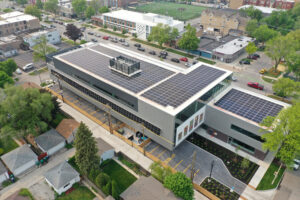
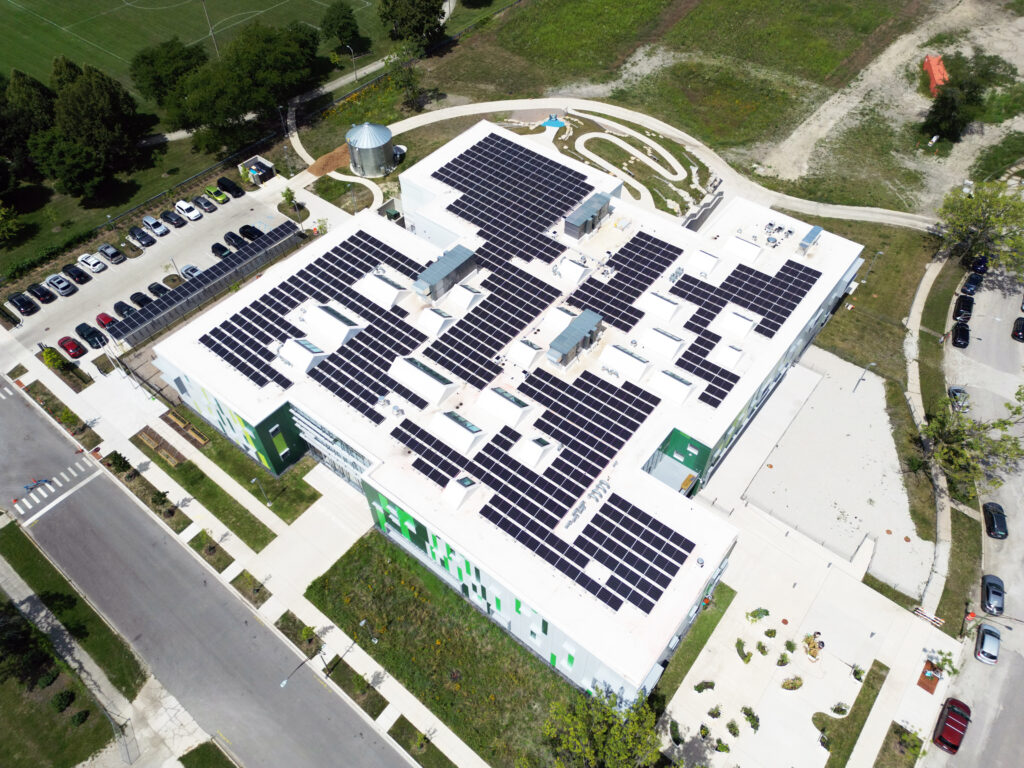
- Simple, rectangular arrays are cheaper to build, easier to string, and require fewer jumpers and roof penetrations.
- They often reduce or eliminate the need for extra attachments and ballast on flat roofs, which is critical for staying under structural pounds‑per‑square‑foot limits.
- Fewer scattered “islands” of modules means simpler wiring, fewer terminations, and usually fewer points of failure.
But aesthetic priorities and late‑stage coordination can work against this. Architects may prefer broken‑up arrays to preserve roof lines; MEP decisions may reserve only irregular leftover spaces for solar.
Windfree’s team has seen, on real Illinois projects, how that can quietly drive up cost and risk: more ballast, more attachments, more labor, and a more complex service environment for the next 25 years.
The remedy is early, integrated coordination on new building projects:
- Involve the commercial solar team in schematic design, not after CDs are 90% complete.
- Reserve large, contiguous zones for solar early, even before final module counts are known.
- Treat solar as a core part of the net zero and green buildings strategy, not a rooftop afterthought.
Done right, you get arrays that are structurally efficient, cost‑effective, and easier to design with robust stringing and minimal shading—a pattern Windfree has replicated across many commercial roofs.
A practical decision framework for project teams
For owners, architects, and developers working with partners like Windfree Solar on commercial projects, a few guiding questions can simplify technology selection:
-
How complex is the shading environment—now and in 10–20 years?
This is a huge one, because we’re not just looking at your roof today; we’re looking into its future. If your roof has a wide-open relationship with the sun and minimal shading, a thoughtfully designed system with string inverters can be a wonderfully efficient workhorse. But if your roof has more complex shading—from a chimney, a dormer, or that big, beautiful oak tree next door—we need a more nimble strategy. The same goes if that tiny sapling in the yard is destined for greatness in 10 years. In those cases, we’ll recommend microinverters or DC optimizers. This tech allows each panel to operate independently, so a shadow on one won’t drag down the performance of its neighbors. It’s about planning for the sun you’ll have tomorrow, not just the sun you have today.
-
How constrained is the layout?
We look at your roof as the canvas for your personal power plant. If that canvas is a large, open rectangle (think a modern commercial roof or a ground-mounted system), we can design a beautifully simple and powerful array. But most homes have more character—and with character comes complexity. We’re talking about tight spaces, irregular rooflines, vents, and skylights. For these unique layouts, a one-size-fits-all approach falls short. By using more sophisticated design and technology like module-level power electronics (MLPE), we can create a system that fits your roof like a glove, maximizing every available inch of sun-drenched real estate and protecting your long-term energy production.
-
What are the O&M expectations and capabilities?
Your solar system isn’t a one-time transaction; it’s a 25-year relationship. That’s why we have to talk about how we’ll care for it from day one. A system with many individual components, like one with microinverters on every panel, requires a crystal-clear monitoring and service strategy so we can see exactly how everything is performing. This is where the quality of the hardware and the people involved becomes non-negotiable. The proven reliability of the products, the financial stability of the manufacturer who backs the warranty, and the deep, hands-on experience of your installer should weigh heavily in your decision. It’s about building a system you can count on for decades.
-
How central is PV to the project’s net zero or green building goals?
This question gets to the heart of your “why.” If your primary goal is to lower your electric bill, that’s fantastic. But if solar is a central, non-negotiable pillar of a larger mission—like achieving net-zero energy or meeting a high-performance standard from the Illinois Green Alliance—then your system needs to be absolutely bulletproof. In this case, it’s a smart investment to choose an architecture that actively mitigates both performance risk (from shading, etc.) and service risk (from component failure). You’re not just buying solar panels; you’re buying certainty. You’re ensuring this key piece of your sustainability puzzle performs flawlessly so you can meet your goals with total confidence.
Commercial solar is no longer just about filling roof space with panels. For new building projects aiming for net zero and advanced green building certifications, the details of inverter choice, stringing, and layout are where performance is either locked in or lost.
By integrating solar engineering early, coordinating across disciplines, and working with an experienced commercial solar partner like Windfree Solar, project teams can ensure that the promise of their sustainability goals shows up in real‑world production data for decades.