Residential Solar
Artificial intelligence can write essays, create art, diagnose diseases, and beat world champions at complex games. But strip away the algorithms and neural networks, and AI runs on something remarkably simple: electricity converted from sunlight.
Every major AI company—OpenAI, Google, Microsoft, Meta—is racing to secure renewable energy for their data centers. Not because they’re environmentally conscious (though many are), but because solar power provides what AI infrastructure desperately needs: massive amounts of reliable, cost-predictable electricity.
The technology powering the AI revolution is the same technology that can eliminate your ComEd bill.
Solar panels on ChatGPT’s servers work exactly the same way as solar panels on your Chicago roof. Photons hit silicon cells, electrons get knocked loose, electricity flows. The scale differs, but the fundamental technology is identical.
Here’s what makes this interesting for Illinois homeowners: if solar power is good enough for companies betting billions on AI infrastructure, it’s certainly good enough for your household electricity needs. And unlike tech giants negotiating utility-scale solar contracts, you have access to incentive programs that make residential solar remarkably affordable right now.
At Windfree Solar, we’ve been installing the same proven technology for Chicago homeowners for over 15 years. The panels powering AI development are your panels. The electricity generation principle is identical. The only difference is where the power goes—into cloud computing or into your home.
If you’ve been skeptical about whether solar technology is mature enough for reliable home electricity generation, consider this: companies whose entire business depends on uninterrupted power are betting everything on it.
Why AI Companies Are Going All-In on Solar Energy
The Electricity Challenge Facing AI Infrastructure
Training and running AI models requires staggering amounts of electricity. A single large language model training session can consume over 1,000 megawatt-hours—enough to power more than 100 American homes for a year.
But it’s not just the total consumption that creates challenges. AI data centers need:
Constant Availability: Unlike office buildings that can adjust usage based on occupancy, AI infrastructure runs continuously. There’s no “off-peak” period when demand drops. The electricity must be there 24/7, year-round.
Price Predictability: Tech companies operate on multi-year planning cycles. Volatile energy costs create uncertainty in operational budgets and profit projections. They need to know what electricity will cost five or ten years from now, not just this quarter.
Scalability: As AI capabilities expand, electricity requirements grow proportionally. Companies need energy sources that can scale with their infrastructure growth without running into supply constraints.
Grid Independence: During peak demand periods—hot summer afternoons when air conditioning load maxes out regional grids—data centers can’t afford brownouts or voltage fluctuations. They need reliable power independent of broader grid stress.
Solar power addresses all of these requirements simultaneously, which is why AI companies are signing massive power purchase agreements for solar energy and building their own solar installations.
The Economics That Drive the Decision
Tech companies aren’t choosing solar because it’s fashionable. They’re choosing it because the economics are compelling.
Solar electricity costs have dropped approximately 90% over the past decade. For large-scale installations, solar is now the cheapest source of new electricity generation in most of the United States, including Illinois.
More importantly, solar provides cost certainty. When a company signs a 20-year solar power purchase agreement, they lock in electricity pricing for two decades. They’re no longer exposed to fossil fuel price volatility, regional demand spikes, or utility rate increases.
For AI companies whose business models depend on providing services at specific price points, this cost certainty is valuable enough to justify significant infrastructure investment.
Microsoft, for example, has committed to purchasing enough renewable energy to offset 100% of their electricity consumption. Google has been buying renewable energy since 2010 and now has enough contracted solar capacity to power operations equivalent to several million homes.
These aren’t experimental pilots. These are fundamental business decisions driven by operational and financial logic.
Reliability Proven at Scale
Perhaps the most telling indicator of solar technology maturity is that mission-critical operations rely on it.
Companies whose revenue depends on uninterrupted service—where even minutes of downtime cost millions—are powering their infrastructure with solar. They’ve done the reliability analysis. They’ve stress-tested the technology. They’ve evaluated failure modes and redundancy requirements.
Their conclusion: solar is reliable enough to bet the business on.
Modern solar panels come with 25-year performance warranties because manufacturers have decades of field data demonstrating consistent, predictable output. Inverters and mounting systems are equally proven technologies with failure rates measured in fractions of a percent annually.
The technology powering AI isn’t experimental or unproven. It’s mature, reliable, and economically compelling—which is exactly why the world’s most sophisticated companies are deploying it at scale.
The Same Technology Works for Chicago Homes
No Difference in Core Technology
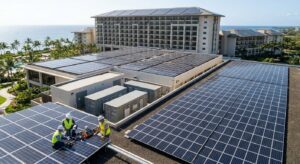
The solar panels on an AI data center roof use the same photovoltaic technology as panels on Chicago residential rooftops. Both convert sunlight into electricity through the photovoltaic effect—photons strike silicon cells, freeing electrons that flow as electrical current.
The fundamental components are identical:
Solar Panels: Residential installations typically use the same panel manufacturers supplying commercial and utility-scale projects. Companies like Hanwha Q CELLS, Silfab, and REC Group produce panels for all market segments. Your panels likely come from the same production lines as panels going to data centers.
Inverters: The devices that convert DC electricity from panels into AC electricity for use in buildings operate on the same principles at residential and commercial scale. Residential installations use string inverters or microinverters; large installations use central inverters. The conversion technology is fundamentally the same, just scaled differently.
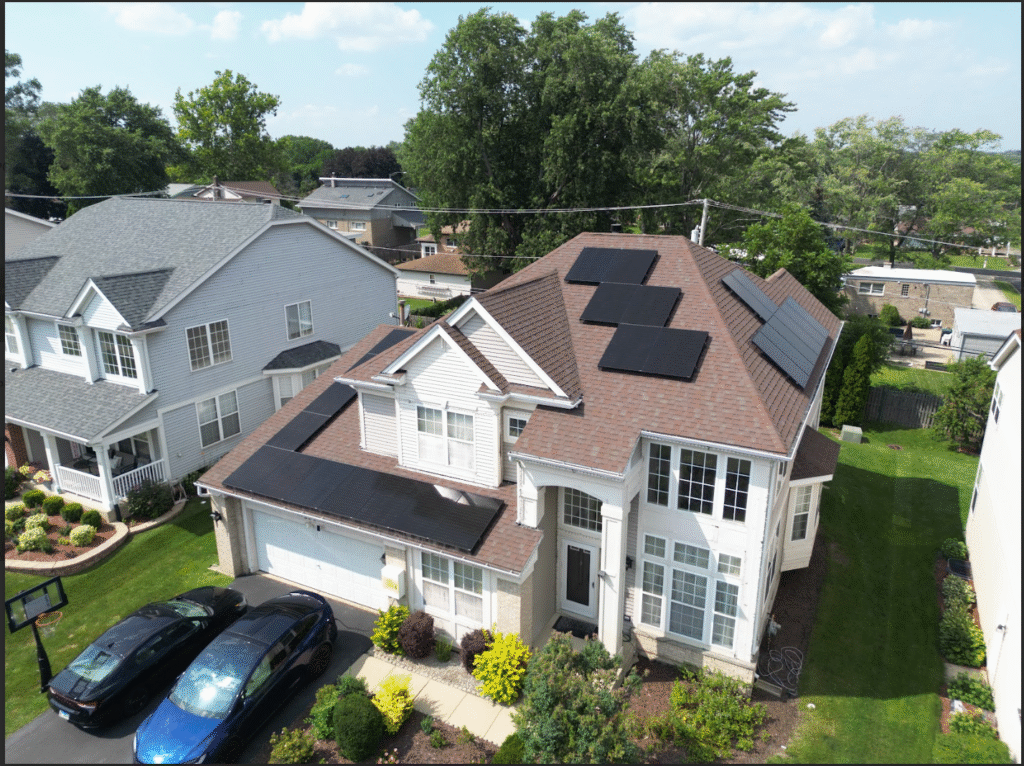
Mounting Systems: Whether panels are mounted on a data center roof or a residential roof in Naperville, the racking and attachment methods follow the same engineering principles and must meet the same wind and snow load requirements.
The only significant differences are scale and configuration, not core technology.
Chicago Weather Doesn’t Stop Solar
If solar works for AI data centers in various climates—including locations with weather similar to or worse than Chicago—it works for Illinois homes.
Solar panels actually perform more efficiently in cold temperatures. While shorter winter days mean less total production, the panels operate at higher efficiency when temperatures are low. The solar industry designs systems accounting for seasonal variation—annual production averages include winter months.
Chicago receives approximately 189 sunny days annually, which is sufficient for economically viable solar production. Many cities with lower solar resources than Chicago have thriving residential solar markets because the technology works across diverse climates.
Snow on panels is a non-issue in practice. Panels are installed at angles that promote snow sliding off. The dark panel surface absorbs heat even on cold days, accelerating melting. And perhaps most importantly, annual production calculations already account for snow coverage—it’s built into the modeling.
We’ve installed hundreds of systems across Chicago and surrounding suburbs over 15 years. They produce reliably year-round, including through harsh winters. The technology isn’t climate-dependent in the way many people assume.
Residential vs. Commercial: What Actually Differs
While the technology is the same, residential installations have some advantages over large commercial projects:
Simpler Permitting: Residential solar permitting in most Chicago suburbs is straightforward. Commercial and utility-scale projects often face complex regulatory hurdles and lengthy approval timelines.
Faster Installation: Residential systems typically install in 1-2 days. You’re generating your own power within weeks of signing a contract, not months or years.
Better Incentives Per Kilowatt: Illinois residential solar incentives (Illinois Shines program) are often more generous per kilowatt installed than commercial programs, making the economics attractive even at smaller scale.
Net Metering Benefits: ComEd’s net metering program allows residential customers to bank excess production as credits, effectively using the grid as a battery. This maximizes the value of every kilowatt-hour your panels produce.
The sophistication and reliability of solar technology that AI companies depend on is fully available to Illinois homeowners, often with better incentive structures than commercial installations receive.
Illinois Solar Incentives Make Home Solar Surprisingly Affordable
The same solar technology that AI companies are deploying is accessible to Illinois homeowners at costs substantially reduced by state and local incentive programs.
Illinois Shines Adjustable Block Program
Illinois Shines provides upfront rebates for residential solar installations. As of 2025, residential systems in ComEd territory receive rebates that can reduce system costs by several thousand dollars.
The program operates in declining blocks—as each funding block fills, rebate rates decrease for the next block. This creates a timing advantage for early adopters. The rebates available today are higher than what will likely be available 12-18 months from now.
Rebate amounts vary based on the current block, but typical residential systems receive $3,000-$5,000 in upfront rebates that directly reduce your out-of-pocket installation cost.
ComEd Net Metering
Net metering is perhaps the most valuable ongoing benefit for Illinois solar customers. When your panels produce more electricity than your home uses (common during sunny midday hours), the excess flows back to the ComEd grid. You receive a credit on your bill at the retail electricity rate.
Later, when your panels aren’t producing—nighttime or cloudy days—you draw electricity from the grid and use those accumulated credits to offset charges.
This effectively lets you use the grid as a battery without the cost of physical battery storage. Your summer overproduction offsets winter months when production is lower. You capture full retail value for every kilowatt-hour your panels generate.
Solar Property Tax Exemption
Illinois law exempts solar installations from property tax assessments. While solar panels typically increase home value by $15,000-$25,000, this added value doesn’t increase your property tax bill.
You get the benefit of increased home value without the burden of higher annual property taxes—a significant long-term financial advantage.
Local Municipal Programs
Several Chicago-area municipalities offer additional solar incentives:
Cook County Sun & Save: Provides additional grants for income-qualified residents installing solar.
City of Evanston Programs: Evanston residents may qualify for city-specific solar incentives that stack with state programs.
Community Solar Options: For residents whose roofs aren’t suitable for solar, community solar programs allow participation in shared solar installations with similar benefits.
Combining these programs creates compelling economics. A typical 8kW residential system costing approximately $28,000 before incentives might have a net cost of $18,000-$20,000 after Illinois Shines rebates, with ongoing value from net metering and property tax exemption.
Declining Incentive Environment Creates Urgency
Illinois Shines rebates intentionally decline as program goals are met. The blocks are filling faster now than in previous years due to increased solar adoption.
The difference between installing solar in early 2025 versus late 2026 could mean $1,000+ in lost rebate value on a typical residential system. Early adopters capture maximum incentives while later adopters receive progressively less support.
Real Economics: What Solar Costs and Saves for Chicago Homeowners
Let’s examine realistic numbers for a typical Chicago-area home:
Household Profile:
- Annual electricity consumption: 10,500 kWh
- Current average ComEd rate: approximately $0.13/kWh
- Current annual electricity cost: $1,365
- Monthly bill average: $114
Solar System Specifications:
- System size: 8.5 kW
- Estimated annual production: 10,800 kWh
- Coverage: approximately 100% of annual usage
System Costs:
- Gross installation cost: approximately $28,000
- Illinois Shines rebate: -$4,000 (approximate, varies by block)
- Net out-of-pocket cost: $24,000
Annual Savings Analysis:
With net metering, the household offsets virtually all electricity consumption. Remaining utility costs consist primarily of connection fees and minimal grid usage during extended cloudy periods.
Estimated remaining annual utility costs: $360 (approximately $30/month)
Annual electricity savings: $1,005
Simple payback period: approximately 24 years
Wait—24 years doesn’t sound compelling, does it?
This is where understanding the complete picture matters:
The Rate Increase Factor:
The payback calculation above assumes ComEd rates remain constant. They won’t.
Illinois residential electricity rates have increased approximately 3-4% annually over the past decade. If this trend continues (and industrial demand from data centers may accelerate it), rates will be significantly higher in 5, 10, and 15 years.
Solar customers lock in their electricity cost at installation. As utility rates increase, the value of solar production increases proportionally, accelerating payback and expanding long-term savings.
Realistic 25-Year Comparison:
No Solar (assuming 3.5% annual rate increase):
Total 25-year electricity cost: approximately $51,000
With Solar:
System cost: $24,000
Minimal ongoing utility fees (25 years): $9,000
Total 25-year cost: $33,000
Net savings: $18,000+
And panels typically continue producing for 30+ years with gradual degradation. The financial advantage extends well beyond the 25-year analysis period.
The Value Beyond Dollars:
Solar provides benefits difficult to quantify financially:
Budget Predictability: You know what your electricity will cost. You’re not subject to rate shock or seasonal bill spikes.
Energy Independence: You’re generating your own power rather than remaining entirely dependent on utility infrastructure and pricing decisions.
Resilience: While grid-tied solar without batteries doesn’t provide backup power during outages, it does reduce your dependence on grid electricity overall.
Environmental Impact: For homeowners who value reducing carbon footprint, solar eliminates tons of CO2 emissions annually equivalent to planting hundreds of trees.
Why Windfree Solar for Your Chicago Home Installation
Technology matters, but installation quality and local expertise matter just as much.
15+ Years of Chicago-Area Experience
We’ve installed residential solar systems throughout Chicago and surrounding suburbs for over 15 years. We understand Chicago weather, local permitting requirements across different municipalities, ComEd interconnection processes, and Illinois incentive program details thoroughly.
Working with installers who know the local landscape prevents complications and delays that can occur when using companies without regional experience.
Complete Incentive Management
We handle all Illinois Shines applications, ComEd interconnection paperwork, and local permit submissions. You don’t navigate bureaucracy—we manage the entire process while you wait for your system to go live.
Our experience with Illinois incentive programs ensures you capture all available rebates and credits. We know which programs you qualify for and how to optimize applications for maximum benefit.
Quality Installation Standards
All our installations meet or exceed industry standards and manufacturer specifications. We use premium mounting systems designed for Chicago wind and snow loads. Our electrical work is performed by licensed electricians. Every system is inspected and approved before activation.
We warranty our installation workmanship separately from manufacturer equipment warranties, giving you additional protection and recourse if any installation-related issues arise.
Realistic Communication
We provide honest assessments of whether your property is suitable for solar and what realistic production and savings expectations are. Not every roof is ideal for solar, and we’ll tell you if yours isn’t.
You’ll understand exactly what system size is recommended, why, what it will produce annually, and what your financial outcome should be. No exaggerated claims or unrealistic projections.
Long-Term Support
Solar panels require minimal maintenance, but questions and occasional issues do arise. We’re a local company that will be here when you need support, not a national installer that might not have local presence years from now.
We’ve supported systems we installed a decade ago. We’ll be here to support yours.
Conclusion
The technology powering the AI revolution is the same technology that can power your home. If it’s reliable enough for companies betting billions on uninterrupted operations, it’s reliable enough for your household electricity needs.
Solar isn’t experimental or unproven. It’s mature, reliable technology with decades of performance data and millions of installations proving consistent results. The AI industry’s massive investment in solar is perhaps the strongest endorsement of the technology’s readiness for mission-critical applications.
For Chicago homeowners, the question isn’t whether solar technology works—AI companies have answered that definitively. The question is whether the economics make sense for your situation.
With Illinois Shines rebates, ComEd net metering, and property tax exemptions, the current incentive environment makes residential solar financially attractive for many Illinois households. Combined with protection against future utility rate increases, solar provides both immediate cost reduction and long-term financial advantage.
The same technology powering tomorrow’s AI is available for your home today—with better incentives than you might expect and proven reliability from over a decade of local installations.
Windfree Solar has been installing residential solar systems throughout Chicago and surrounding suburbs for over 15 years. We handle everything from initial assessment through final activation, ensuring you capture all available incentives while installing a system designed for Chicago conditions.
If you’re ready to power your home with the same proven technology AI companies depend on, let’s talk.
Learn more about residential solar at https://windfree.us/residential-solar/ or contact our team at https://windfree.us/contact/
Discover how the technology powering AI can eliminate your ComEd bill and provide decades of predictable electricity costs.
Windfree Solar serves homeowners throughout Chicago, Naperville, Evanston, Oak Park, and all surrounding suburbs with professional solar installation backed by 15+ years of local experience.